Conferences & Calendar
Our Google calendar below shows all the conferences we consider relevant for the RecSys community, including workshops. To see a list of all events, switch to the “Agenda” tab and select “Look for more. Click the “Add to Google Calendar” at the bottom of the calendar to add the calendar to your own Google account.
This calendar shows only the main dates of conferences, workshops, tutorials, summer schools and other satellite events. No deadlines or similar. It allows you to quickly see which conferences take place.
Table of Contents
ALL Events, One Calendar
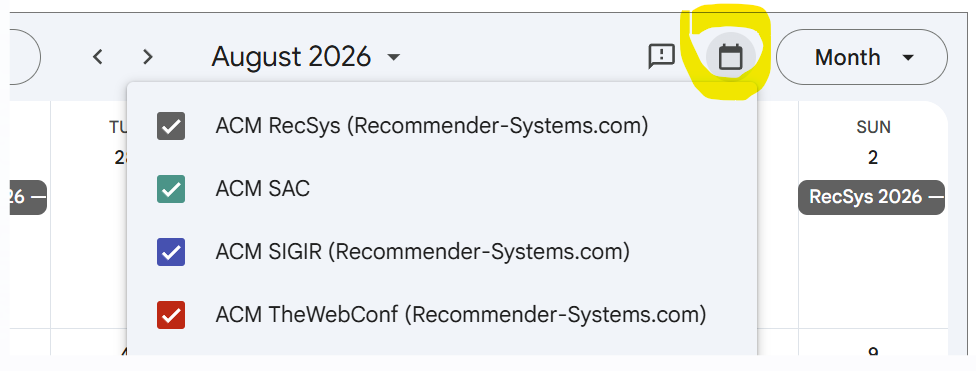
This calendar shows ALL events, including submission deadlines, registration deadlines, etc. As you see it, it’s hardly usable, but you may choose which calendars to see by clicking the calendar icon. Also, in case you are planning a conference yourself, this calendar may help to see when particularly busy times are that you might want to avoid for your conference.
Core Conferences for Recommender-Systems Research
1. RecSys: 2026-09 in Minneapolis (USA); 2027 in Hawaiʻi (USA)
Latest CORE/ICORE ranking: A (ICORE 2026)
Usually held: Late September or early October
Typical full-paper submission: Early to mid-April
First held in 2007, the ACM Conference on Recommender Systems (RecSys) is the primary conference dedicated to recommender systems. It covers algorithms, evaluation, user studies, fairness, interfaces, datasets, and deployed systems. For doctoral researchers whose central research question concerns recommendation, RecSys is usually the most direct venue. Its workshops, tutorials, doctoral activities, and industry participation also make it an important place for entering the research community.
2. SIGIR: 2026-07 in Melbourne (AUS); 2027 in Silicon Valley (USA)
Latest CORE/ICORE ranking: A* (ICORE 2026)
Usually held: July, occasionally extending into early August
Typical full-paper submission: Late January or early February
The ACM Conference on Research and Development in Information Retrieval (SIGIR) is one of the longest-running and most influential conferences on information retrieval. It is highly relevant when a recommender-systems contribution concerns ranking, retrieval, personalized search, user behavior, neural information access, or evaluation. Recommendation papers are particularly suitable when their results also advance the broader problem of helping users find relevant information.
There is also an Asian-Pacific version of SIGIR, the International ACM SIGIR Conference on Information Retrieval in the Asia Pacific (SIGIR-AP). It’s usually held in November or December Typical with full-paper submissions in July. SIGIR-AP was first held in 2023 and serves the information-retrieval community in the Asia-Pacific region while remaining open to international submissions.
3. UMAP: 2026-06 in Gothenburg (SWE); 2027 in Chicago (USA)
Latest CORE/ICORE ranking: A (ICORE 2026)
Usually held: June or July
Typical full-paper submission: Late January or early February
The ACM Conference on User Modeling, Adaptation and Personalization (UMAP) developed from the User Modeling and Adaptive Hypermedia conference series. It concentrates on systems that model users and adapt their behavior or presentation accordingly. It is especially relevant to preference elicitation, explainability, adaptive interfaces, personalization, longitudinal user modeling, and studies of how people interact with recommender systems.
4. TheWebConf: 2026-06 in Dubai (ARE); 2027-05 in Dublin (IRL)
Latest CORE/ICORE ranking: A* (ICORE 2026)
Usually held: April or May, although individual editions may occur later
Typical full-paper submission: Late September or early October in the preceding year
The ACM Web Conference (TheWebConf; formerly WWW) began in 1994 and accompanied the development of the Web as a research field. Its broad scope includes web mining, social networks, online platforms, information retrieval, machine learning, and user behavior. It is particularly suitable for recommender-systems work involving web-scale data, online marketplaces, creator ecosystems, social or platform effects, and responsible web technologies.
5. WSDM: 2026-02 in Boise (USA); 2027-02 in Hong Kong (HKG)
Latest CORE/ICORE ranking: A (ICORE 2026)
Usually held: February or early March
Typical full-paper submission: Early to mid-August in the preceding year
First held in 2008, the ACM International Conference on Web Search and Data Mining (WSDM) focuses on search, data mining, and the analysis of web and social-web data. Recommender systems form a recurring part of its program, particularly through work on ranking, representation learning, user modeling, graph methods, and large-scale behavioral data. It is a strong choice for technically focused recommendation research with a clear connection to search or web mining.
6. CIKM: 2026-11 in Rome (ITA); 2027 in Sydney (AUS)
Latest CORE/ICORE ranking: A (ICORE 2026)
Usually held: Late October or early November
Typical full-paper submission: Mid- to late May
The ACM International Conference on Information and Knowledge Management (CIKM) has been held annually since 1992 and brings together information retrieval, databases, knowledge management, data mining, and artificial intelligence. Recommendation papers are common when they involve knowledge graphs, heterogeneous data, representation learning, large-scale information access, or the integration of recommendation with data-management systems.
7. ECIR: 2026-03 in Delft (NLD); 2027-03 in Southampton (GBR)
Latest CORE/ICORE ranking: A (ICORE 2026)
Usually held: Late March or early April
Typical full-paper submission: Late September or early October in the preceding year
The European Conference on Information Retrieval (ECIR) originated as the BCS Information Retrieval Specialist Group’s annual colloquium in 1979 and adopted its present name in 2002. It regularly includes recommender-systems research and is particularly suitable for personalized search, retrieval-based recommendation, evaluation, user behavior, and work connecting recommendation with information access. Its comparatively focused community can be helpful for doctoral researchers seeking sustained interaction and detailed feedback.
8. CLEF: 2026-09 in Jena (DEU); 2027-09 in Bucharest (ROU)
Latest CORE/ICORE ranking: B (ICORE 2026)
Usually held: September
Typical full-paper submission: May
The Conference and Labs of the Evaluation Forum (CLEF) combines a peer-reviewed conference with evaluation labs and shared tasks on information access. Its scope explicitly includes recommender systems, multilingual and multimodal information access, interactive and conversational evaluation, collaborative and social data, user studies, fairness, reproducibility, datasets, and evaluation methodology. It is especially relevant when a recommender-systems contribution centers on rigorous evaluation, benchmark construction, reproducible experimentation, or recommendation across languages and modalities.
For recommender-systems researchers, CLEF is particularly suitable for work on conversational recommendation, multilingual and cross-cultural recommendation, multimodal recommendation, user simulation, evaluation metrics, shared datasets, and comparative benchmarking. Its labs provide common tasks and test collections through which competing methods can be evaluated under controlled conditions. A paper whose main contribution is a new recommendation algorithm without a substantial evaluation or information-access contribution will usually fit RecSys, SIGIR, WSDM, ECIR, or CIKM better.
9. LREC: 2026-05 in Palma de Mallorca (ESP); 2027 not held
Latest CORE/ICORE ranking: B (ICORE 2026)
Usually held: May or June, generally every two years
Typical full-paper submission: October or November in the preceding year
The Language Resources and Evaluation Conference (LREC) has been held since 1998 and is a major venue for datasets, language resources, annotation, tools, benchmarks, and evaluation methodologies. It is directly relevant when the main contribution is a reusable conversational-recommendation dataset, a multilingual resource, an annotation scheme, a benchmark, an evaluation protocol, or infrastructure for studying text-rich recommender systems. For recommender-systems researchers, LREC is particularly valuable because many current questions cannot be addressed through algorithm development alone. Work on conversational recommendation, explanations, review understanding, multilingual recommendation, user simulations, and language-model evaluation often depends on carefully constructed resources. A resource paper should document collection, consent, annotation, quality control, limitations, licensing, and intended use. A paper whose main contribution is a new recommendation algorithm will usually fit another venue better.
10. ACM Hypertext: 2026-09 in London (GBR); 2027 location TBA
Latest CORE/ICORE ranking: A in CORE 2018; no separate ICORE 2026 entry
Usually held: Late summer or early autumn
Typical full-paper submission: March or April
The ACM Conference on Hypertext and Social Media (ACM Hypertext) has been held since 1987 and studies linked information, social media, navigation, and hypermedia systems. It can suit recommendation research involving adaptive navigation, social information, link structures, content discovery, or the presentation of algorithmically selected information.
Related Conferences by Research Contribution
Human-Centered and Interactive Recommender Systems
The ACM SIGCHI conference family is important when the contribution concerns how people experience, understand, control, or collaborate with recommender systems. RecSys itself is an ACM SIGCHI conference.
CHI: 2026-04 in Barcelona (ESP); 2027 in Pittsburgh (USA)
Latest CORE/ICORE ranking: A* (ICORE 2026)
Usually held: April or May
Typical full-paper submission: Early to mid-September in the preceding year
The ACM Conference on Human Factors in Computing Systems (CHI) is ACM SIGCHI’s main conference and has shaped human-computer interaction research since the early 1980s. It is a leading venue for studies of explanations, trust, control, decision making, accessibility, perceived fairness, and the behavioral effects of recommendation. A competitive CHI paper normally needs a substantial human-centered contribution supported by appropriate user research.
CSCW: 2026-10 in Salt Lake City (USA); 2027 location TBA
Latest CORE/ICORE ranking: A (ICORE 2026)
Usually held: October or November
Typical full-paper submission: Rolling journal-style submissions under the current publication model
The ACM Conference on Computer-Supported Cooperative Work and Social Computing (CSCW) is relevant to group and social recommendation, creator and community perspectives, multi-stakeholder systems, platform governance, moderation, and the social consequences of algorithmic curation. Researchers should examine its current publication process carefully because it differs from a conventional annual conference deadline.
IUI: 2026-07 in Limassol (CYP); 2027-02 in Helsinki (FIN)
Latest CORE/ICORE ranking: A (ICORE 2026)
Usually held: March or April, although individual editions may occur later
Typical full-paper submission: August to October in the preceding year
The ACM Conference on Intelligent User Interfaces (IUI) studies the intersection of artificial intelligence and human-computer interaction. It is a natural venue for mixed-initiative recommender systems, conversational recommendation, preference elicitation, explanations, user control, and interfaces that combine human input with adaptive AI.
Machine Learning. Artificial Intelligence, and Data Mining Conferences
General machine-learning and data-mining conferences regularly publish recommender-systems research. They usually expect a contribution that extends beyond one application or dataset. Suitable papers may introduce a learning method, theoretical result, evaluation methodology, benchmark, or scalable system with broader relevance.
Topics with a natural connection to these venues include representation learning, graph learning, sequential decision making, contextual bandits, reinforcement learning, causal inference, counterfactual evaluation, robustness, privacy, fairness, generative modeling, and scalable training or serving. A paper that mainly applies an established method to a recommendation dataset will usually fit RecSys, SIGIR, WSDM, ECIR, or CIKM better.
For doctoral researchers, these conferences are important even when they are not the intended publication venue. Many methodological developments that later shape recommender systems first appear at NeurIPS, ICML, ICLR, KDD, or ICDM. Their workshops may offer an entry point for early-stage work, although workshop papers should not be treated as equivalent to papers in the main proceedings.
NeurIPS: 2026-12 in Sydney (AUS); 2027 location TBA (Europe)
Latest CORE/ICORE ranking: A* (ICORE 2026)
Usually held: Late November or December
Typical full-paper submission: Early May
Established in 1987, the Conference on Neural Information Processing Systems (NeurIPS) covers machine learning, statistics, optimization, neuroscience, and AI systems. Recommender-systems papers are most competitive when they introduce methods with implications beyond recommendation, such as new representation-learning approaches, sequential-learning methods, causal estimators, privacy mechanisms, robustness techniques, or generative models.
ICML: 2026-07 in Seoul (KOR); 2027 location TBA (South America)
Latest CORE/ICORE ranking: A* (ICORE 2026)
Usually held: July
Typical full-paper submission: Late January or early February
The International Conference on Machine Learning (ICML) is one of the main conferences devoted to machine learning. It is relevant to recommender-systems researchers working on ranking objectives, off-policy learning, contextual bandits, sequential recommendation, uncertainty, causal learning, or learning from biased feedback. The central contribution should normally be a general machine-learning result.
ICLR: 2026-04 in Rio de Janeiro (BRA); 2027-04 in California (USA; city TBA)
Latest CORE/ICORE ranking: A* (ICORE 2026)
Usually held: April or May
Typical full-paper submission: Late September or early October in the preceding year
The International Conference on Learning Representations (ICLR) was launched in 2013 and is closely associated with deep learning and open peer review. It is relevant through embeddings, graph neural networks, transformers, self-supervised learning, multimodal models, generative recommendation, and language-model-based systems. A competitive submission should advance representation learning or another general learning problem rather than only improve results on recommendation benchmarks.
AutoML: 2026-09 in Ljubljana (SVN); 2027 location TBA
The International Conference on Automated Machine Learning (AutoML) focuses on automating the design and optimization of machine-learning systems, including model selection, hyperparameter optimization, neural architecture search, pipeline construction, and multi-objective optimization. It is particularly relevant to Automated Recommender Systems (AutoRecSys), where AutoML methods can automate decisions such as algorithm selection, feature processing, embedding dimensions, model architectures, and hyperparameters.
More broadly, AutoML is relevant to the automation of complete recommender-system pipelines. Instead of optimizing individual models in isolation, AutoML can jointly address preprocessing, candidate generation, ranking, configuration, and evaluation. The conference is therefore a suitable venue when the main contribution advances methods for automatically designing, configuring, or evaluating recommender systems and their pipelines.
KDD: 2026-08 in Jeju (KOR); 2027-08 in San Jose (USA)
Latest CORE/ICORE ranking: A* (ICORE 2026)
Usually held: August
Typical full-paper submission: Under the current two-cycle model, approximately late July in the preceding year or early February in the conference year
The ACM SIGKDD Conference on Knowledge Discovery and Data Mining (KDD) developed from the knowledge-discovery workshop series and has been an annual conference since 1995. It is one of the most relevant general conferences for recommender systems, particularly for ranking, engagement prediction, graph-based recommendation, causal methods, multi-objective optimization, experimentation, large-scale infrastructure, and industrial applications.
KDD commonly distinguishes between research-oriented and applied contributions. The research track is suitable for broadly applicable methodological advances, while applied tracks may accommodate substantial lessons from deployed recommendation systems. Authors should check the current track structure and submission cycle.
ICDM: 2026-11 in Shenyang (CHN); 2027 location TBA
Latest CORE/ICORE ranking: A* (ICORE 2026)
Usually held: November or December
Typical full-paper submission: Late May or early June
The IEEE International Conference on Data Mining (ICDM) has been held annually since 2001 and covers data-mining theory, algorithms, systems, and applications. It is suitable when a recommender-systems paper introduces a broadly applicable data-mining method, particularly for graphs, sequences, streams, behavioral data, advertising, or e-commerce.
AAAI: 2026-01 in Singapore (SGP); 2027-02 in Montréal (CAN)
Latest CORE/ICORE ranking: A* (ICORE 2026)
Usually held: January or February
Typical full-paper submission: Late July or early August in the preceding year
The AAAI Conference on Artificial Intelligence (AAAI) has been held since 1980 and covers the full range of artificial intelligence. It may suit recommendation research involving reasoning, knowledge graphs, agents, planning, explainability, fairness, causal decision making, or sequential interaction.
IJCAI: 2026-08 in Bremen (DEU); 2027 location TBA
Latest CORE/ICORE ranking: A* (ICORE 2026)
Usually held: July or August
Typical full-paper submission: January
The International Joint Conference on Artificial Intelligence (IJCAI) was first held in 1969 and is one of the longest-running broad AI conferences. It is relevant to intelligent agents, knowledge-based and constraint-based recommendation, preference reasoning, multi-agent allocation, explainability, and sequential decision making.
NLP, Conversational Recommendation, and Language Resources
Natural language processing is increasingly important to recommender systems through conversational interfaces, language-model-based recommendation, text-rich user and item representations, review analysis, natural-language explanations, and generative retrieval. NLP conferences are suitable when the paper makes a clear contribution to language processing, linguistic resources, or language-oriented evaluation.
ACL, EMNLP, and EACL commonly use ACL Rolling Review. Authors submit their paper to a review cycle and subsequently commit the reviewed paper to a conference. The relevant review deadline may therefore be several months before the conference commitment deadline.
ACL: 2026-07 in San Diego (USA); 2027-08 in Kyoto (JPN)
Latest CORE/ICORE ranking: A* (ICORE 2026)
Usually held: June to August
Typical full-paper submission: January or February through ACL Rolling Review
The Annual Meeting of the Association for Computational Linguistics (ACL) is the flagship conference of the Association for Computational Linguistics. It is relevant to conversational recommendation, language-model-based representations, dialogue, natural-language explanations, retrieval-augmented generation, and language-oriented evaluation. A strong submission should advance an NLP research question rather than merely use an existing language model within a recommender system.
EMNLP: 2026-10 in Budapest (HUN); 2027 location TBA (Mexico or Central America)
Latest CORE/ICORE ranking: A* (ICORE 2026)
Usually held: October or November
Typical full-paper submission: May or June through ACL Rolling Review
The Conference on Empirical Methods in Natural Language Processing (EMNLP) emphasizes empirical NLP research and is relevant to recommendation based on dialogue, reviews, user-generated content, text generation, or language models. Authors should provide strong language baselines, error analysis, and appropriate evaluation of generated or interpreted text.
EACL: 2026-03 in Rabat (MAR); 2027-03 in Athens (GRC)
Latest CORE/ICORE ranking: A (ICORE 2026)
Usually held: March or April
Typical full-paper submission: August to October in the preceding year through ACL Rolling Review
The Conference of the European Chapter of the Association for Computational Linguistics (EACL) has a scope similar to ACL and covers multilingual NLP, dialogue, generation, information extraction, and language resources. It can be a good venue for language-centered recommendation, particularly in multilingual or cross-cultural settings.
COLING: 2026 not held; 2027-05 in Macau (MAC)
Latest CORE/ICORE ranking: B (ICORE 2026)
Usually held: In odd-numbered years under the current schedule; the month varies
Typical full-paper submission: During the preceding autumn, increasingly through ACL Rolling Review
The International Conference on Computational Linguistics (COLING) dates back to 1965 and covers a broad range of computational-linguistics research. It may suit recommendation work involving multilinguality, dialogue, text-based preference modeling, generation, or linguistic analysis when the language contribution is central.
Multimodal, Visual, and Embodied Recommendation
Computer-vision conferences can be relevant to fashion, food, media, tourism, and product recommendation, as well as multimodal item understanding and generative content systems. Robot-learning conferences are relevant to embodied assistants, preference learning from interaction, and systems that recommend actions in physical environments. The paper must contribute to vision or robot learning rather than merely use images or a robot in a recommendation application.
ICCV: 2026 not held; 2027-10 in Hong Kong (HKG)
Latest CORE/ICORE ranking: A* (ICORE 2026)
Usually held: September or October in odd-numbered years
Typical full-paper submission: February or March
The IEEE/CVF International Conference on Computer Vision (ICCV) is relevant when recommendation research advances visual representation learning, multimodal retrieval, vision-language modeling, generative visual systems, or visual understanding of products and media. Adding image features to an otherwise conventional recommender model is normally insufficient.
ECCV: 2026-09 in Malmö (SWE); 2027 not held
Latest CORE/ICORE ranking: A* (ICORE 2026)
Usually held: September or October in even-numbered years
Typical full-paper submission: February or March
The European Conference on Computer Vision (ECCV) has been held since 1990 and alternates with ICCV as a major computer-vision venue. It can suit work on multimodal item representations, fashion and product understanding, visual retrieval, vision-language models, or generative media when the visual-learning contribution is broadly applicable.
CoRL: 2026-11 in Austin (USA); 2027 location TBA
Latest CORE/ICORE ranking: Unranked (ICORE 2026)
Usually held: October or November
Typical full-paper submission: May or June
The Conference on Robot Learning (CoRL) was launched in 2017 and focuses on the intersection of robotics and machine learning. It is relevant only when recommendation is embedded in physical interaction, such as assistive robots, personalized robotic behavior, preference learning from human feedback, or action recommendation in an embodied environment.
News About Recommender-Systems Events
ACM RecSys 2026 Proceedings by the numbers: More Industry, Bigger Teams, More Generative Everything
RecSys, the ACM Conference on Recommender Systems, is back in Minneapolis for its 20th edition, and the proceedings are not online. The first RecSys took place here in 2007. According to the official RecSys statistics, it received 35 long-paper submissions and accepted 16. This year, 361 long papers were submitted and 64 accepted. I used […]
ACM RecSys Conference 2027 officially announced: August 23–27, Hawaii.
ACM RecSys 2027 will take place in Honolulu, Oʻahu, Hawaiʻi, from August 23–27, 2027, at the Hilton Hawaiian Village Waikiki Beach Resort (Google Maps). The news has just been announced by ACM RecSys on LinkedIn. RecSys 2027 will be the 21st ACM Conference on Recommender Systems. The three General Co-Chairs are Christine Bauer, Joeran Beel, […]
ACM RecSys 2026 Introduces a Rather Different Call: Tell the History of Recommender Systems in 60 Seconds
ACM RecSys 2026 has quietly added a rather unusual call for contributions. And quietly is the important word here: the call appeared only a few days ago. With submissions due on September 4, this is very much a short-notice opportunity. So, if you want to participate, do not put this one onto the usual academic […]
ACM RecSys Reviews Were Due — Now Comes the SPC Triage
The ACM RecSys review deadline has passed. Reviews were due on May 27, and the review process is now in one of its less visible but important phases: collecting the last missing reviews, checking whether each paper has enough useful feedback, and preparing for rebuttal. For some Senior Program Committee members, this is a relatively […]
What the RecSys Steering Committee agenda 2026 tells young researchers
Alan Said — chair of the ACM Recommender Systems Steering Committee — recently shared a short update from the ACM RecSys Steering Committee via LinkedIn. Since I am also a member of that committee, I thought it might be useful to add a bit of context for PhD students and other early-career researchers who know […]
ACM UMAP 2026 Registration Opens
ACM UMAP 2026 opens registration. 11 days left to benefit from early-bird pricing. Unfortunately, 25% VAT is added to all prices. The payment company, gave me this additional information: According to Skatteverket (the Swedish Tax Agency) output VAT at a rate of 25% must be charged on the participation fee for a conference. As of […]
Call for Papers for ACM RecSys 2026: No LBR but R&P Notes + ‘Past, present and future papers’
ACM RecSys 2026 has published its Call for Contributions, so the yearly ritual can begin: staring at AoE deadlines, renaming drafts (“last one”, “very last one”, “very last one 2”), and pretending the camera-ready date is “far away.” The conference will take place in Minneapolis, Minnesota (USA), September 28 to October 2, 2026, with the […]
ACM RecSys 2026 in Minneapolis: A note about safety from the organizers
RecSys 2026’s general chairs put out a LinkedIn and WhatsApp note, and it’s one of those posts you read with that little knot in your stomach and then exhale a bit when you reach the end. People have been pinging them about Minneapolis, whether they’re okay, and whether it’s even sensible to plan travel. They […]
ACM RecSys 2026: Call for Student Volunteers
The call for student volunteers at RecSys 2026 is out, and if you are even remotely considering an academic or research career, you should read it and apply. RecSys is where our field gathers in full force, and you learn as much from the conversations as from the papers. The conference will be in Minneapolis, […]
ACM UMAP conference now A-ranked: What does it mean for the RecSys community?
ACM UMAP just got an upgrade that many academics quietly care about. The UMAP 2026 website states that the conference is ranked A (“Excellent”) in the ICORE 2026 rankings. For anyone who has ever had to translate “this venue is great” into committee-speak, an A label is a very usable sentence. In the CORE/ICORE ecosystem, […]
ACM RecSys 2026 Proceedings by the numbers: More Industry, Bigger Teams, More Generative Everything
RecSys, the ACM Conference on Recommender Systems, is back in Minneapolis for its 20th edition, and the proceedings are not online. The first RecSys took place here in 2007. According to the official RecSys statistics, it received 35 long-paper submissions and accepted 16. This year, 361 long papers were submitted and 64 accepted. I used […]
POPROX Brings Recommender-Systems Experiments Out of the Offline Lab (and News Recommendations to Users)
In 2023, we reported on a $2 million NSF project led by Joseph Konstan at the University of Minnesota. The project aimed to build shared infrastructure that would enable academic researchers to conduct recommender-system experiments with real users. Three years later, this infrastructure has developed into a functioning service with a user base, research publications, […]
ACM RecSys Conference 2027 officially announced: August 23–27, Hawaii.
ACM RecSys 2027 will take place in Honolulu, Oʻahu, Hawaiʻi, from August 23–27, 2027, at the Hilton Hawaiian Village Waikiki Beach Resort (Google Maps). The news has just been announced by ACM RecSys on LinkedIn. RecSys 2027 will be the 21st ACM Conference on Recommender Systems. The three General Co-Chairs are Christine Bauer, Joeran Beel, […]
ACM RecSys 2026 Introduces a Rather Different Call: Tell the History of Recommender Systems in 60 Seconds
ACM RecSys 2026 has quietly added a rather unusual call for contributions. And quietly is the important word here: the call appeared only a few days ago. With submissions due on September 4, this is very much a short-notice opportunity. So, if you want to participate, do not put this one onto the usual academic […]
ACM TOIS, the Big Sister of ACM TORS: Min Zhang’s Term as Editor-in-Chief Ends as the Impact Factor Rises to 11.2
When it comes to journals, Recommender-Systems.com usually focuses on ACM Transactions on Recommender Systems, or TORS. The reason is obvious: TORS is the ACM journal devoted to our field. Yet there is another journal in the “ACM Transactions on” family that recommender-systems researchers should follow closely. ACM Transactions on Information Systems, or TOIS, has published […]
ACM RecSys Reviews Were Due — Now Comes the SPC Triage
The ACM RecSys review deadline has passed. Reviews were due on May 27, and the review process is now in one of its less visible but important phases: collecting the last missing reviews, checking whether each paper has enough useful feedback, and preparing for rebuttal. For some Senior Program Committee members, this is a relatively […]
What the RecSys Steering Committee agenda 2026 tells young researchers
Alan Said — chair of the ACM Recommender Systems Steering Committee — recently shared a short update from the ACM RecSys Steering Committee via LinkedIn. Since I am also a member of that committee, I thought it might be useful to add a bit of context for PhD students and other early-career researchers who know […]
ACM UMAP 2026 Registration Opens
ACM UMAP 2026 opens registration. 11 days left to benefit from early-bird pricing. Unfortunately, 25% VAT is added to all prices. The payment company, gave me this additional information: According to Skatteverket (the Swedish Tax Agency) output VAT at a rate of 25% must be charged on the participation fee for a conference. As of […]
Call for Papers for ACM RecSys 2026: No LBR but R&P Notes + ‘Past, present and future papers’
ACM RecSys 2026 has published its Call for Contributions, so the yearly ritual can begin: staring at AoE deadlines, renaming drafts (“last one”, “very last one”, “very last one 2”), and pretending the camera-ready date is “far away.” The conference will take place in Minneapolis, Minnesota (USA), September 28 to October 2, 2026, with the […]
ACM RecSys 2026 in Minneapolis: A note about safety from the organizers
RecSys 2026’s general chairs put out a LinkedIn and WhatsApp note, and it’s one of those posts you read with that little knot in your stomach and then exhale a bit when you reach the end. People have been pinging them about Minneapolis, whether they’re okay, and whether it’s even sensible to plan travel. They […]