ACM RecSys Reviews Were Due — Now Comes the SPC Triage
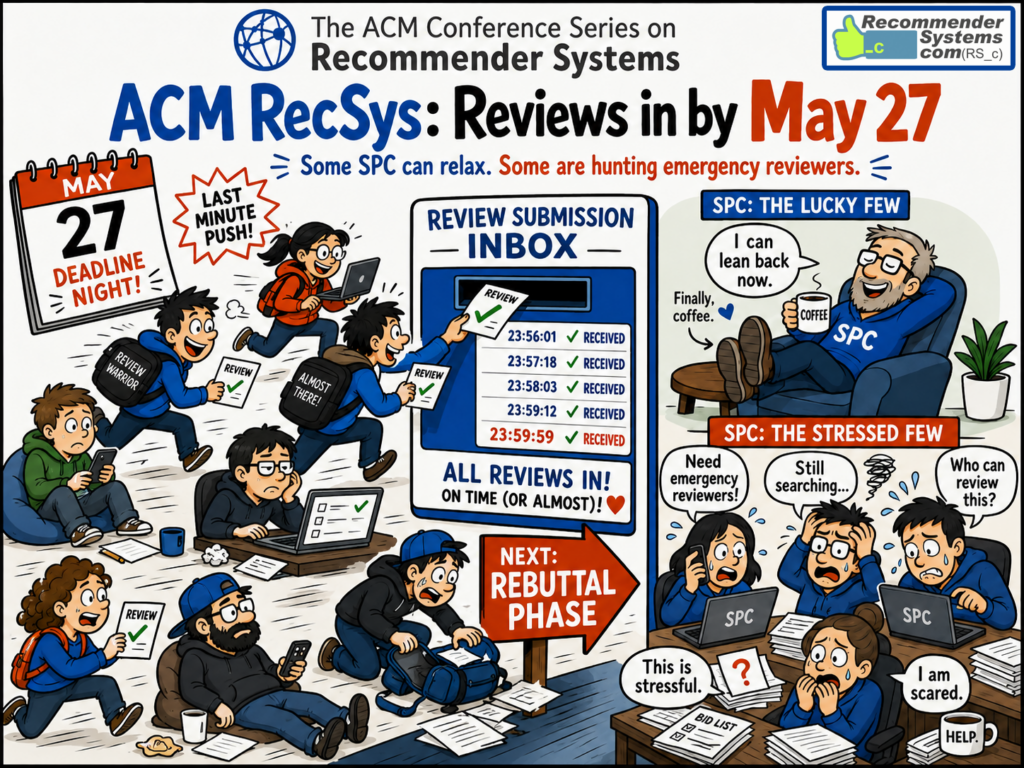
The ACM RecSys review deadline has passed. Reviews were due on May 27, and the review process is now in one of its less visible but important phases: collecting the last missing reviews, checking whether each paper has enough useful feedback, and preparing for rebuttal.
For some Senior Program Committee members, this is a relatively calm moment. Their assigned papers have received the necessary reviews, the reviewers submitted on time or close enough to the deadline, and the SPC member can briefly lean back, drink coffee, and wait for the next phase.
For others, this is the stressful part.
Not every review arrives when expected. Some reviewers need reminders. Some reviews are incomplete. Some reviewers disappear at the worst possible moment. When that happens, SPC members have to chase missing reviews, assess whether the available reviews are sufficient, and sometimes find emergency reviewers at very short notice. This is not glamorous work, but it is essential. Without it, papers may not receive a fair evaluation, and the decision process becomes weaker.
It is also worth remembering how much work reviewing itself requires. A full research paper is not something one can assess properly in a few minutes. A serious review means reading the paper carefully, understanding the contribution, checking the related work, evaluating the methodology, looking at the experiments, judging the claims, and writing feedback that is useful for both authors and the program committee. Reviewing multiple full papers in parallel is substantial academic labor, usually done on top of teaching, supervision, administration, grant writing, and one’s own research.
That does not make late reviews less frustrating. It does explain why the final days before and after the deadline are often chaotic. The review process depends on a large number of people doing careful work under time pressure. Most reviewers do their part. A few need reminders. A few need replacements. The SPC members are the ones who have to make the system hold together.
The next major step is the rebuttal phase.
Rebuttal period: June 4–9
During rebuttal, authors will have the opportunity to respond to the reviews. This is the moment to clarify misunderstandings, correct factual errors, answer reviewer questions, and point to relevant parts of the paper that may have been overlooked. A rebuttal is not a second submission and not a place to rewrite the paper. It is a short, focused response to the issues raised in the reviews.
For authors, the best preparation is to read the reviews carefully, identify the central points, and respond in a calm and factual way. Not every criticism needs a long answer. The strongest rebuttals usually address the points that could materially affect the assessment of the paper.
For SPC members and reviewers, the work continues after rebuttal. The responses need to be read, the reviews may need to be reconsidered, and discussions may be needed before final recommendations can be made.
So the current state is simple: the review deadline has passed, most reviews are in, the last missing reviews are being chased, some SPC members can relax, others are still searching for emergency reviewers, and rebuttal starts soon.
To the reviewers who submitted thoughtful reviews on time: thank you.
To the SPC members currently chasing missing reviews: good luck.
To the emergency reviewers: sorry, and thank you in advance.

ACM RecSys 2025 to be held in Prague

ACM/IEEE Joint Conference on Digital Libraries (JCDL) 2022 has a RecSys Track
ACM RecSys Registration 2024 Opens NOW
About The Author

Joeran Beel
I am the founder of Recommender-Systems.com and head of the Intelligent Systems Group (ISG) at the University of Siegen, Germany https://isg.beel.org. We conduct research in recommender-systems (RecSys), personalization and information retrieval (IR) as well as on automated machine learning (AutoML), meta-learning and algorithm selection. Domains we are particularly interested in include smart places, eHealth, manufacturing (industry 4.0), mobility, visual computing, and digital libraries. We founded or maintain, among others, LensKit-Auto, Darwin & Goliath, Mr. DLib, and Docear, each with thousand of users; we contributed to TensorFlow, JabRef and others; and we developed the first prototypes of automated recommender systems (AutoSurprise and Auto-CaseRec) and Federated Meta Learning (FMLearn Server and Client).