What the RecSys Steering Committee agenda 2026 tells young researchers
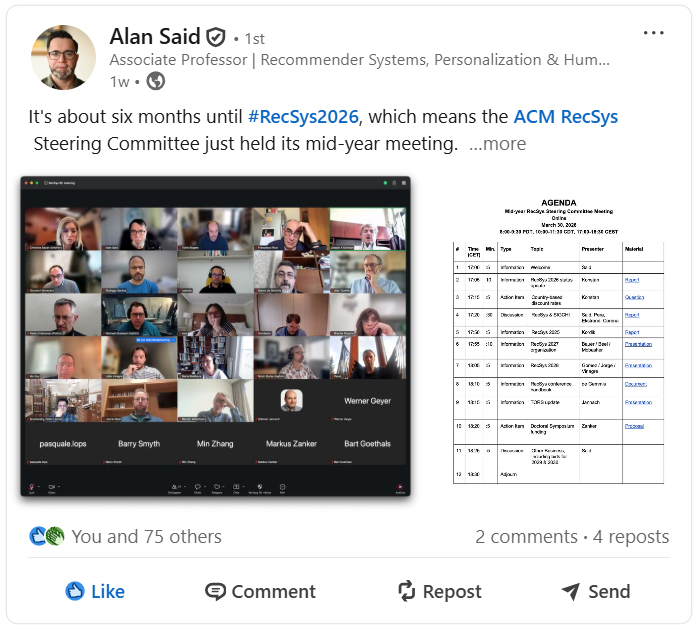
Alan Said — chair of the ACM Recommender Systems Steering Committee — recently shared a short update from the ACM RecSys Steering Committee via LinkedIn.
Since I am also a member of that committee, I thought it might be useful to add a bit of context for PhD students and other early-career researchers who know the conference mainly through submissions, reviews, and presentations, but are less familiar with its underlying structures.
The basic role of the Steering Committee is to provide continuity for the ACM RecSys conference series year to year. A conference like ACM RecSys, with 1000+ participants each year, is not organized from scratch every year. It builds on previous editions and has to coordinate future ones well in advance. That is why the committee looks across multiple years at once rather than focusing only on the next conference.
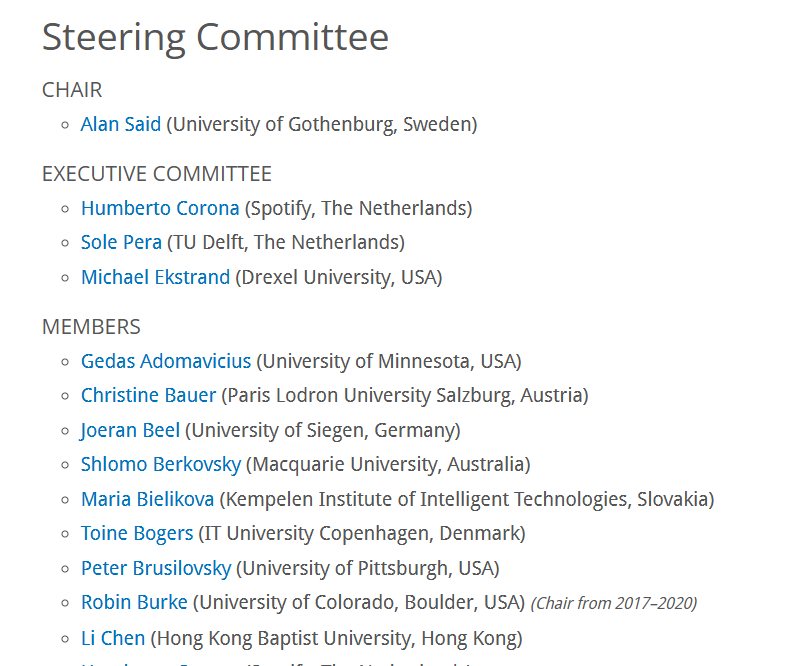
It is also worth noting who sits on such a committee. In practice, this includes people who have taken major roles in previous ACM RecSys conferences, especially General Chairs and Program Chairs, along with other highly established researchers who have contributed substantially to the community over time. So the committee brings together experience from earlier editions and broader knowledge of how the field and the conference have developed.
The agenda in Alan’s post gives a good sense of what that work looks like in practice. It includes reports on the past RecSys 2025, the upcoming RecSys 2026, the organization of RecSys 2027, planning for RecSys 2028, and even bids for 2029 and 2030. For younger researchers, that is a useful context. It shows that a flagship conference is not just a yearly deadline cycle. It is an ongoing series that requires handover, planning, and coordination across many editions.
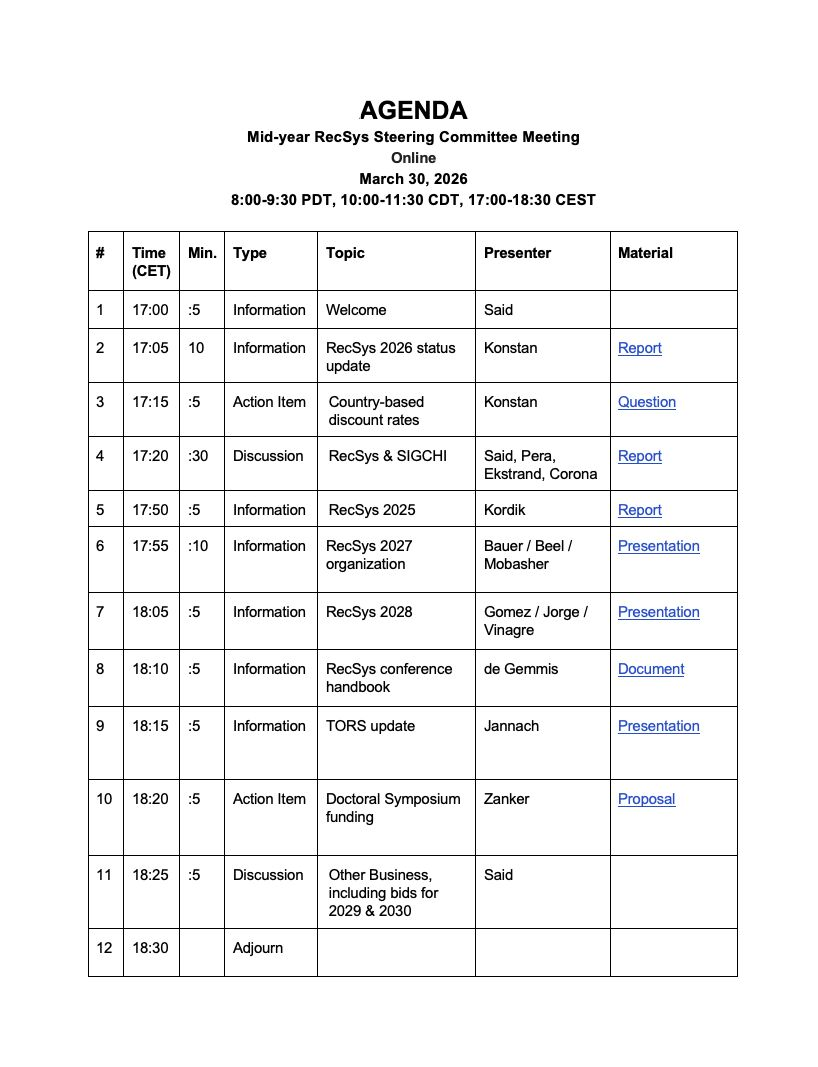
One agenda item concerns the RecSys conference handbook. That may sound procedural, but it is actually easy to understand why it matters. A handbook helps document how things are done, what roles exist, which decisions need to be made, and what future organizers should know. In other words, it helps turn experience into shared memory for the conference series.
Another agenda item is “RecSys & SIGCHI.” For readers who have not come across that term before, SIGCHI is the ACM Special Interest Group on Computer-Human Interaction. More generally, ACM’s Special Interest Groups (SIG) are the structures within ACM that organize communities around specific areas of computing and support conferences, publications, and other activities. In practical terms, being part of a SIG means that the conference is embedded in a larger organizational framework. Budgets and financial processes are handled there, some decisions need approval there, and support mechanisms such as student grants may also come through that structure.
For recommender-systems researchers, this connection also matters beyond administration. RecSys is of course a technical conference, but recommendation is not only about prediction and optimization. It also touches interaction, explanation, interface design, user control, and the way systems are experienced in practice. So when the agenda includes the relation between RecSys and SIGCHI, that points both to governance and to the broader academic setting in which the field sits.
The agenda also mentions doctoral symposium funding. That item is directly relevant for PhD students. The doctoral symposium is one of the places where early-career researchers can present developing work, receive focused feedback, and connect with others at a similar stage. Since funding appears explicitly on the agenda, one may also hope that there could be additional activities around doctoral training in 2026, perhaps even another summer school. That is not something that happens every year, so for now it remains a hope rather than an announcement.
Another item on the agenda is TORS, the ACM Transactions on Recommender Systems. Seeing TORS on the Steering Committee agenda is a reminder of how closely the journal and the conference community are aligned. That is not entirely natural and it is worth noting. In many fields, journals and conferences exist side by side without being discussed together in this way. In the RecSys community, the connection appears close enough that it becomes part of the committee’s regular discussions.
For PhD students, I think there is a simple takeaway here. A conference is not only a place where papers are presented. It is also a community with structures, responsibilities, and long-term coordination behind the scenes. The Steering Committee is one part of that. It connects conference leadership across years and helps make sure that RecSys continues to develop as a coherent series rather than as a sequence of isolated annual events.
And there is also a more personal point. If you are early in your research career, this may feel very far away. But one day, you may well find yourself serving the community in roles like these. A first step toward that is, of course, to do excellent research and publish it at ACM RecSys. But there are other ways to become part of the community as well. One very good example is to serve as a student volunteer: https://recsys.acm.org/recsys26/recsys-student-volunteers/
That is often one of the best entry points into the conference community and a very practical way to see how the field works from the inside.

ACM RecSys Conference 2027 officially announced: August 23–27, Hawaii.

ACM UMAP conference now A-ranked: What does it mean for the RecSys community?

Is SIGIR 2025 desk-rejecting RecSys manuscripts only to reverse its decision later?
About The Author

Joeran Beel
I am the founder of Recommender-Systems.com and head of the Intelligent Systems Group (ISG) at the University of Siegen, Germany https://isg.beel.org. We conduct research in recommender-systems (RecSys), personalization and information retrieval (IR) as well as on automated machine learning (AutoML), meta-learning and algorithm selection. Domains we are particularly interested in include smart places, eHealth, manufacturing (industry 4.0), mobility, visual computing, and digital libraries. We founded or maintain, among others, LensKit-Auto, Darwin & Goliath, Mr. DLib, and Docear, each with thousand of users; we contributed to TensorFlow, JabRef and others; and we developed the first prototypes of automated recommender systems (AutoSurprise and Auto-CaseRec) and Federated Meta Learning (FMLearn Server and Client).