
Recsperts Didn’t Stop at Episode #20 — I Just Forgot Writing About It
Back in November 2023, I wrote that Recsperts was becoming a constant in the recommender-systems community. The occasion was episode #20, in which Marcel Kurovski talked with Bram van den Akker about practical bandits and travel recommendations. At the time, the podcast had been running for roughly two years.
Then I apparently forgot about it.
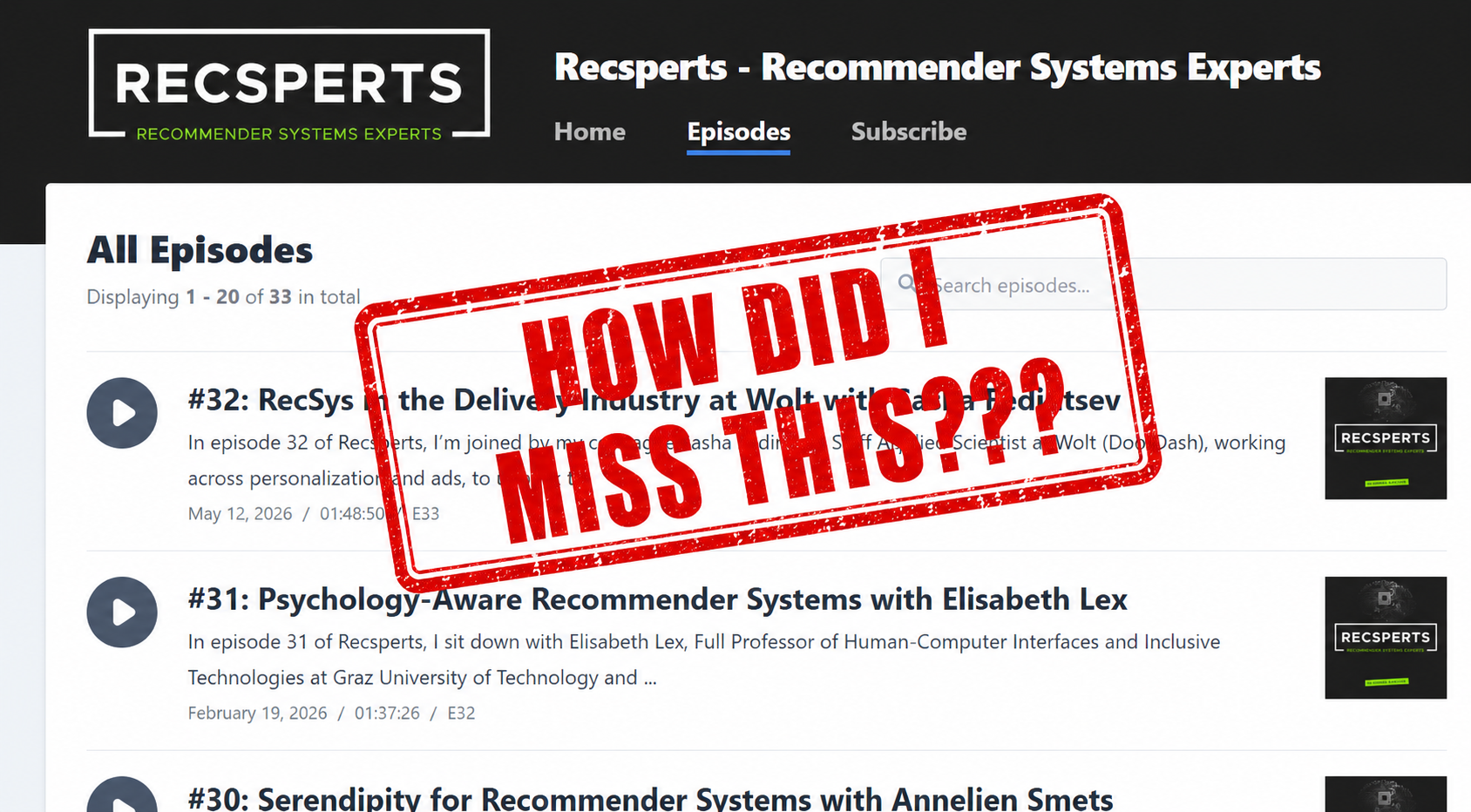
Fortunately, Marcel did not. Recsperts has meanwhile reached episode #32. Since episode #20 in November 2023, twelve more numbered episodes have appeared, with the latest released in May 2026. That works out to roughly one new episode every two to three months on average. The releases are not perfectly regular, but that is hardly the point. Recsperts is not trying to be a weekly news show. Its strength is long-form conversations with people who have something substantial to say about recommender systems. And Marcel has simply kept doing the work.
The result is becoming something of an oral archive of modern recommender-systems research. There are academics, industrial researchers, public-service recommenders, large-scale commercial systems, and topics ranging from transformers to psychology. Most episodes run for around 90 minutes or longer. That is not exactly TikTok-compatible, but it gives the discussions room to get beyond the usual “what is your research about?” level.
One episode that stands out is #23, Generative Models for Recommender Systems with Yashar Deldjoo. Published in August 2024, it covers the development from VAEs and GANs to LLM-based recommendation, but also spends time on evaluation, risks, harms, multimodal recommendation, and adversarial robustness. Looking at the field from 2026, that balance is important. Generative recommendation has produced no shortage of enthusiasm. Asking how these systems should actually be evaluated remains the less glamorous and arguably more useful question.
Episode #28, Multistakeholder Recommender Systems with Robin Burke, is another one I would particularly recommend. Robin argues that essentially every recommender system is a multistakeholder system. Users matter, but so do providers, platform operators, advertisers, creators, and others whose interests may conflict. The conversation moves from the history of recommender systems to fairness, reranking, social choice, and what Robin calls “post-userist” recommender systems. It also asks an increasingly relevant question: what happens to human content providers if recommender systems become filled with generated content?
Then there is #30, Serendipity for Recommender Systems with Annelien Smets. Serendipity is one of those concepts that recommender-systems researchers often like to put next to novelty and diversity and then turn into a metric. Smets makes the problem rather more interesting. Her framework distinguishes intended, experienced, and afforded serendipity. A system cannot simply “generate serendipity” by injecting random items. It can create conditions under which useful unexpected encounters become more likely. The discussion of Netflix’s discontinued “Surprise Me” feature is also a useful reminder that unexpectedness is not automatically a good user experience.
Episode #31, Psychology-Aware Recommender Systems with Elisabeth Lex, continues in a similar human-centered direction. Elisabeth discusses cognition, emotion, personality, memory, and the limits of treating people primarily as vectors of past interactions. The episode goes back to Grundy, one of the earliest recommender systems, and then connects psychology-informed recommendation to modern approaches such as ACT-R, collaborative filtering, and hybrid AI. Particularly relevant is the discussion of evaluation: clicks and accuracy tell us something, but they tell us surprisingly little about whether a recommender actually helped a person achieve a goal.
There are several others I would put on the listening list. #21 with Martijn Willemsen on User-Centric Evaluation and Interactive Recommender Systems is a natural companion to the Elisabeth Lex episode. Martijn discusses decision psychology, user control, negative feedback, longitudinal experiments, and why “behaviorism is not enough.” That last phrase is more than a good podcast chapter title. It summarizes a problem that recommender-systems research has been struggling with for two decades: observable interaction is convenient to optimize, but convenience should not be mistaken for a complete model of the user.
I also liked the choice of guests in #27, Recommender Systems at the BBC with Alessandro Piscopo and Duncan Walker. Commercial recommenders dominate both research datasets and industry discussions. The BBC has a different problem. Recommendations have to coexist with public-service objectives and editorial decisions across news, video, audio, and other products. This makes questions about values and objectives unusually explicit. The episode is a good example of why “maximize engagement” is not a universal specification for a recommender system.
For readers interested in the more technical end of the spectrum, #29 on Transformers for Recommender Systems with Craig Macdonald and Sasha Petrov is worth the 97 minutes. It covers SASRec, BERT4Rec, negative sampling, efficient training, quantized item representations, and generative sequential recommendation. I especially appreciate that the conversation includes their replication work on BERT4Rec. Recommender-systems research has a long history of improvements that become less impressive once baselines and evaluation protocols are inspected carefully. Talking about replication alongside new models is healthy.
And the current latest episode, #32, RecSys in the Delivery Industry at Wolt with Sasha Fedintsev, brings things back to production. Delivery recommendation comes with locality constraints, rapidly changing context, availability, repeat purchases, latency requirements, and logged-data biases. In other words, many of the assumptions that make recommender-system experiments tidy disappear rather quickly. The episode traces Wolt’s development from collaborative filtering to neural and transformer-based approaches and is a useful counterweight to papers in which the item catalog politely remains stationary.
Looking back, my 2023 description of Recsperts as a “constant entity” in the community turned out to be more accurate than my subsequent coverage of it. Marcel has kept the podcast alive and, more importantly, has kept the quality and breadth high. Twelve additional episodes may not sound enormous in the era of daily AI podcasts. But producing a well-prepared, technically informed conversation every few months for years is arguably more valuable than producing another stream of weekly commentary on whatever happened on X yesterday.
So, belatedly: well done, Marcel. And for anyone else who, like me, has not checked Recsperts for a while, the episode archive is worth another visit. There is now quite a backlog. In this particular case, that is good news.

About The Author

Joeran Beel
I am the founder of Recommender-Systems.com and head of the Intelligent Systems Group (ISG) at the University of Siegen, Germany https://isg.beel.org. We conduct research in recommender-systems (RecSys), personalization and information retrieval (IR) as well as on automated machine learning (AutoML), meta-learning and algorithm selection. Domains we are particularly interested in include smart places, eHealth, manufacturing (industry 4.0), mobility, visual computing, and digital libraries. We founded or maintain, among others, LensKit-Auto, Darwin & Goliath, Mr. DLib, and Docear, each with thousand of users; we contributed to TensorFlow, JabRef and others; and we developed the first prototypes of automated recommender systems (AutoSurprise and Auto-CaseRec) and Federated Meta Learning (FMLearn Server and Client).