
Robin Burke on Social Choice for Fair Recommendations — and a Recommender-Systems Podcast I Had Missed
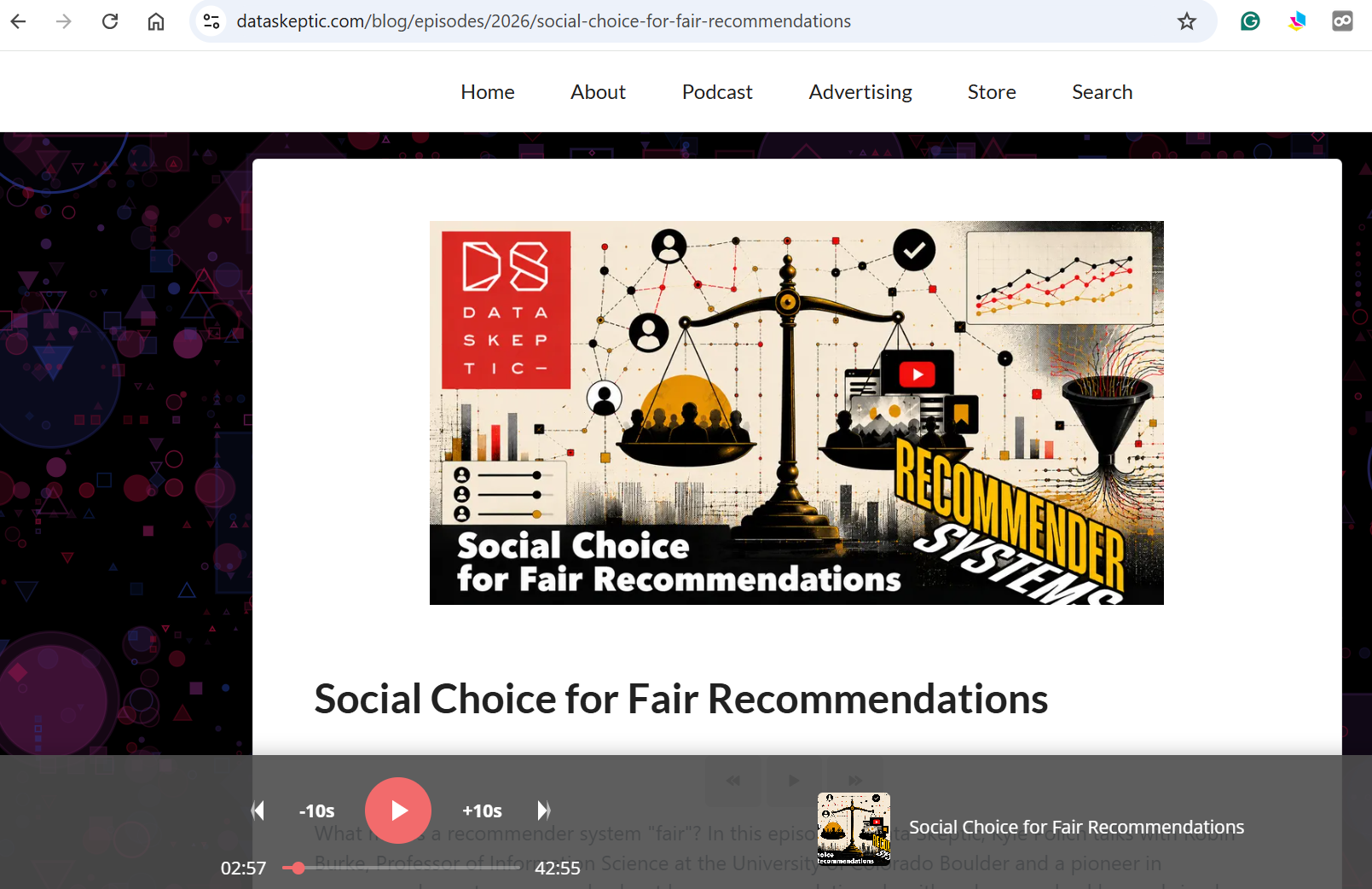
A recent episode of Data Skeptic caught my attention: Social Choice for Fair Recommendations, featuring Robin Burke. The 43-minute conversation starts with the history of recommender systems, but its main topic is a much more current question: what does it actually mean for a recommender system to be fair? More specifically, how should a system behave when users, item providers, platforms, and perhaps society have interests that do not neatly agree with each other?
Robin Burke is a particularly suitable person for this discussion. He is Professor and Chair of Information Science at the University of Colorado Boulder (soon moving to UCD in Ireland). He clearly does not need an introduction to members of the recommender-systems community, which he helped to found and develop into the field it is today. His current research focuses on fairness, accountability, transparency, and the integration of objectives from different stakeholders. Burke received his PhD in Computer Science from Northwestern University in 1993.
That date is relevant to the podcast. Burke explains that his dissertation already dealt with a problem that today would probably be called recommendation, although the term “recommender system” was not yet in common use. His route into the field came partly through case-based reasoning. The basic idea was to retrieve previous cases that resemble a current problem and adapt them. It is not a large conceptual jump from there to retrieving items that fit a user’s current needs. Burke later worked on knowledge-based recommendation and became one of the early researchers studying how different recommendation paradigms could be combined.
Many recommender-systems researchers will know Burke from his 2002 paper “Hybrid Recommender Systems: Survey and Experiments.” At the time, content-based, collaborative, and knowledge-based recommendation were often treated as rather separate camps. Burke’s work systematically examined ways of combining them. Today, using all available signals sounds almost obvious. Twenty-five years ago, it was much less so. The podcast contains a nice bit of academic self-deprecation here: Burke notes that some combinations he had considered impractical in his taxonomy were subsequently built by other researchers. Predicting the future of recommender systems is apparently difficult even when you helped shape their past.
The central part of the episode concerns SCRUF-D, or Social Choice for Recommendation Under Fairness – Dynamic. The underlying observation is important. Fairness in recommendation is rarely one objective. A recommender may want to provide good results to users while also ensuring reasonable exposure for different providers. Different groups may even require different definitions of fairness. SCRUF-D models such fairness concerns as separate agents. An allocation step decides which concerns should matter for a particular recommendation situation. An aggregation step then combines their preferences with those of the underlying recommender, using mechanisms inspired by social choice and voting.
The word “agent” deserves a small warning in 2026. This is not primarily about giving an LLM a browser, some memory, and permission to book a restaurant. The agents represent fairness concerns and participate in a formal decision mechanism. The terminology happens to sound very contemporary, but the research predates much of the current enthusiasm for LLM-based agents. Burke and colleagues have been developing social-choice approaches to fairness-aware recommendation for several years. Burke’s work on multi-sided fairness goes back at least to 2017, while subsequent work formalized dynamic multi-agent social choice and, more recently, heterogeneous fairness definitions.
This is also where I find the work particularly relevant to recommender systems. Recommendation is inherently a multi-stakeholder problem. A user wants relevant items. A seller, artist, journalist, job candidate, or content creator wants exposure. A platform has its own objectives. And there may be societal objectives concerning diversity, discrimination, or access to information. Optimizing one scalar called “fairness” can hide these conflicts rather than solve them. Social choice provides a language for representing them explicitly.
Of course, social choice does not magically remove the difficult decisions. Someone still has to decide which fairness concerns receive an agent, how fairness is measured, which groups are represented, and how competing preferences are aggregated. Changing the voting or allocation mechanism can change the outcome. In that sense, SCRUF-D does not solve the political part of fairness. It makes that political part more visible and computationally tractable. I see that as a strength, although moving from simulations and research datasets to large production recommender systems will remain the more difficult test. The researchers themselves show that different choice and allocation mechanisms lead to different fairness–accuracy trade-offs.
The podcast also led me to something I had somehow missed so far: Data Skeptic itself. Data Skeptic is hosted by Kyle Polich and covers data science, statistics, machine learning, and artificial intelligence. Episodes are organized into seasons around a common theme and are usually interviews with researchers and experts. And, rather conveniently for readers of Recommender-Systems.com, Data Skeptic has devoted an entire season to recommender systems.
I had not really been aware of Data Skeptic before this. That is a little embarrassing given the name of this blog. A search for “recommender system” on the Data Skeptic website made the oversight rather obvious. My saved search-results page contained ten other episodes directly concerned with recommender systems. They cover a surprisingly broad part of the field:
- Networks and Recommender Systems — an introduction to the recommender-systems season and the connection between network science and recommendation.
- Shilling Attacks on Recommender Systems — Aditya Chichani discusses attacks in which fake profiles manipulate collaborative-filtering systems.
- Sustainable Recommender Systems for Tourism — Ashmi Banerjee discusses exposure bias, sustainability, and recommendation in tourism.
- Collective Altruism in Recommender Systems — Ekaterina “Kat” Fedorova looks at strategic users who coordinate their behaviour in response to recommendation algorithms.
- Eye Tracking in Recommender Systems — Santiago de Leon discusses gaze data, positional bias, and what eye tracking can reveal that clicks cannot.
- Disentanglement and Interpretability in Recommender Systems — Ervin Dervishaj discusses whether disentangled representations actually improve interpretability and recommendation performance.
- Healthy Friction in Job Recommender Systems — Roan Schellingerhout discusses explainable job matching and systems that have to serve job seekers, recruiters, and companies.
- Designing Recommender Systems for Digital Humanities — Florian Atzenhofer-Baumgartner considers recommendation for historical archives, where discovery and serendipity may matter more than clicks.
- The Future is Agentic in Recommender Systems — Yashar Deldjoo discusses trustworthy recommendation, LLMs, and the move from ranked lists toward systems capable of completing larger tasks.
- Niche vs Mainstream — Anas Buhayh discusses multi-stakeholder fairness and recommender systems that behave differently for niche and mainstream users.
What I like about this collection is that it does not reduce recommender systems to collaborative filtering plus a few ranking metrics. Security, fairness, sustainability, strategic behaviour, interpretability, human attention, employment, cultural heritage, and agents all appear. That is a reasonable reflection of what the field has become. The question is increasingly not just “Can we predict what somebody will click?” but “What kind of system are we building, who does it serve, and what happens after we deploy it?”
The Robin Burke episode is a good entry point because it connects both ends of that history. Burke was working on recommendation-like problems before the field had settled on its name. He is now working on questions of stakeholder representation and fairness that may define an important part of its future. And I have apparently acquired another recommender-systems podcast backlog. There are worse problems to have.

About The Author

Joeran Beel
I am the founder of Recommender-Systems.com and head of the Intelligent Systems Group (ISG) at the University of Siegen, Germany https://isg.beel.org. We conduct research in recommender-systems (RecSys), personalization and information retrieval (IR) as well as on automated machine learning (AutoML), meta-learning and algorithm selection. Domains we are particularly interested in include smart places, eHealth, manufacturing (industry 4.0), mobility, visual computing, and digital libraries. We founded or maintain, among others, LensKit-Auto, Darwin & Goliath, Mr. DLib, and Docear, each with thousand of users; we contributed to TensorFlow, JabRef and others; and we developed the first prototypes of automated recommender systems (AutoSurprise and Auto-CaseRec) and Federated Meta Learning (FMLearn Server and Client).