Call for Papers for ACM RecSys 2026: No LBR but R&P Notes + ‘Past, present and future papers’
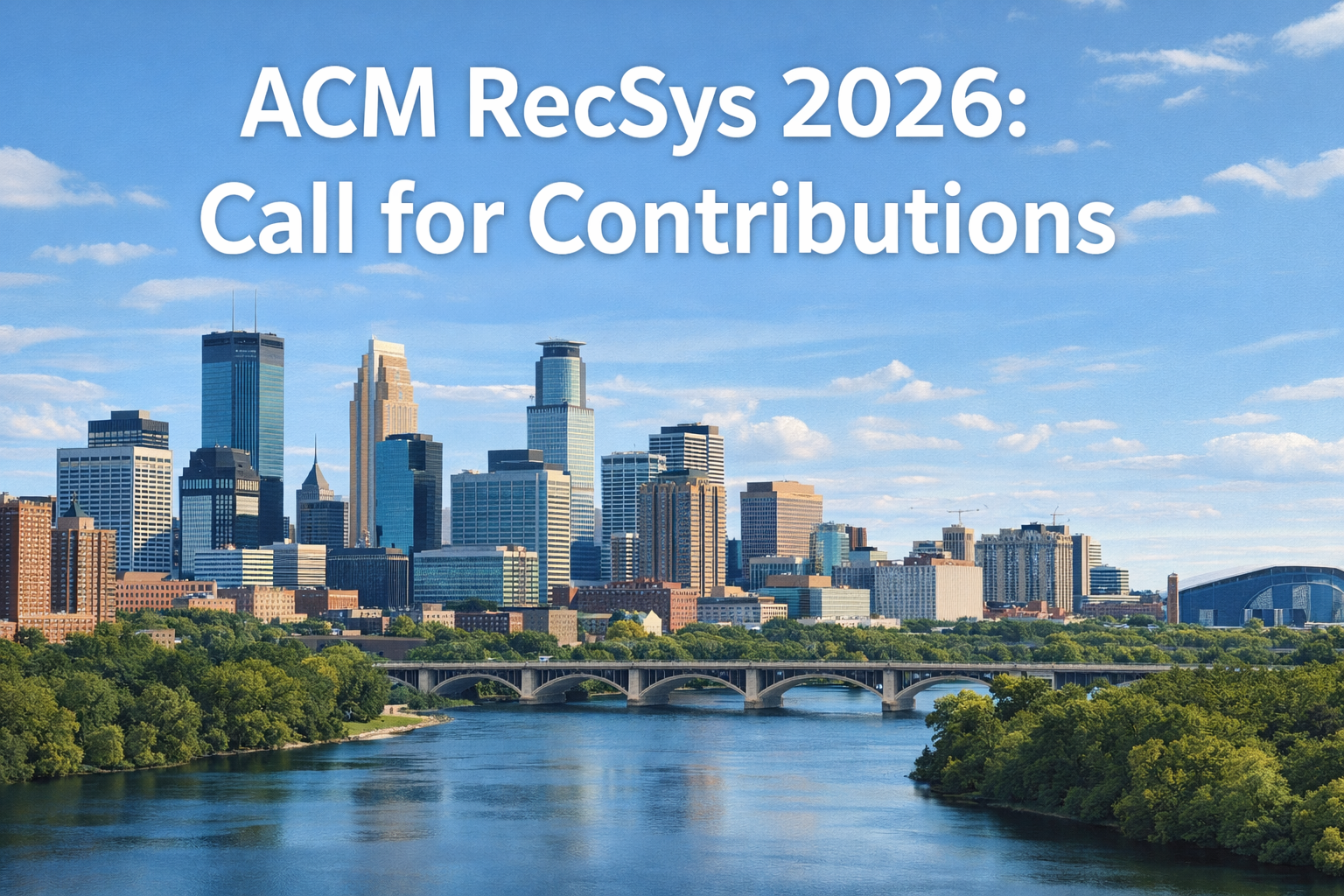
ACM RecSys 2026 has published its Call for Contributions, so the yearly ritual can begin: staring at AoE deadlines, renaming drafts (“last one”, “very last one”, “very last one 2”), and pretending the camera-ready date is “far away.” The conference will take place in Minneapolis, Minnesota (USA), September 28 to October 2, 2026, with the Doctoral Symposium scheduled for September 27.
The heart of the CFP is the Main Track, which explicitly bundles three paper types: long papers, short papers, and “Past, Present, and Future” papers (the latter serving as the venue for position pieces, historical reflections, and forward-looking agendas). For planning purposes, the two dates that matter most are the main-track abstract deadline on April 14, 2026, and the full paper deadline on April 21, 2026 (AoE).
One process detail deserves a small celebration: RecSys 2026 keeps a rebuttal phase for main-track papers (June 4–9). The format is intentionally constrained: a short, anonymous rebuttal intended only to flag factual errors or misconceptions in reviews. That constraint is healthy. It nudges the community toward “review correction” rather than “review negotiation,” and it tends to improve decision discussions without turning into a second round of paper-writing.
Beyond the main track, the Reproducibility track is again prominent, and it makes the scope very clear: there are reproducibility/replicability papers and resource papers (datasets, open-source frameworks, and similar infrastructure). The key deadlines are an abstract due April 28 and the paper due May 5, 2026 (AoE).
Industry contributions remain a full proceedings track, and the CFP stresses real-world challenges, deployed systems, and practical evaluation realities, while explicitly rejecting “sales pitches.” The one date to keep in mind here is May 21, 2026 as the industry paper deadline (AoE).
Now to the change that will spark hallway debates: I could not find any Late-Breaking Results (LBR) poster submission track in the RecSys 2026 CFP navigation or text. That is, frankly, a bit sad. LBR posters have historically been a low-friction entry point, especially for students and for ideas that are exciting but not yet “main-track crisp.” For context, RecSys 2025 explicitly listed “Late-Breaking Results” among its contribution types.
That said, RecSys 2026 introduces a new category that partially fills the same ecosystem niche: Research and Practice Notes (R&P Notes). This track is explicitly positioned for ideas still in development with promising preliminary results, and it is also framed as not precluding future publication. Submissions are short (extended-abstract style), presented as posters, and published by ACM; the CFP also notes that they are published as extended abstracts under ACM’s open model, with APCs not applying in the same way as full papers. The deadline to remember is July 15, 2026 (AoE).
The remaining contribution types are also live and worth flagging, even if most readers only need one date each: workshop proposals are due March 10, tutorial proposals are due April 28, doctoral symposium submissions are due June 9, and demos are due July 15 (AoE). Importantly, demos and R&P Notes share that same mid-July deadline, which will likely create a mini “poster-track season” in many labs.
From a recommender-systems perspective, the overall package feels aligned with where the field is going. The main track’s topic list leans into human-centered work, multi-stakeholder settings, multimodality, and “generative, agentic, and reasoning-based recommendation,” which mirrors the community’s ongoing shift from ranking-only pipelines toward interactive systems that must justify themselves in messy environments.

Public Photo/Video Drop & View for the ACM RecSys Conference 2022

Accepted RecSys Papers & RecSys Bias Workshop at the ECIR2022 Conference

Stats on Submitted & Accepted Papers and Acceptance Rate at the ACM Recommender Systems Conference until 2023
About The Author

Joeran Beel
I am the founder of Recommender-Systems.com and head of the Intelligent Systems Group (ISG) at the University of Siegen, Germany https://isg.beel.org. We conduct research in recommender-systems (RecSys), personalization and information retrieval (IR) as well as on automated machine learning (AutoML), meta-learning and algorithm selection. Domains we are particularly interested in include smart places, eHealth, manufacturing (industry 4.0), mobility, visual computing, and digital libraries. We founded or maintain, among others, LensKit-Auto, Darwin & Goliath, Mr. DLib, and Docear, each with thousand of users; we contributed to TensorFlow, JabRef and others; and we developed the first prototypes of automated recommender systems (AutoSurprise and Auto-CaseRec) and Federated Meta Learning (FMLearn Server and Client).