RS_c moves from X/Twitter to LinkedIn as the primary social channel
For years, RS_c treated X (and Twitter before it) as the natural place to “ship” recommender-systems news. You published a post, you dropped a link, you added #recsys, and the right people would see it. Some would reply. Some would quote-tweet with a better paper. Some would disagree in a way that was strangely productive. That loop made the whole field feel smaller, faster, and more conversational than academia usually is. Lately, though, that loop has been breaking. The most obvious symptom is that the #recsys stream feels quiet.
So here is the pragmatic decision: RS_c will use LinkedIn as its primary social media channel going forward. The main job of social media, for us, is distribution. We want to make sure new posts actually reach people who care. If the community is no longer gathering around #recsys on X, then optimizing for X is optimizing for nostalgia.
So, the new URL to visit and follow is: https://www.linkedin.com/company/Recommender-Systems
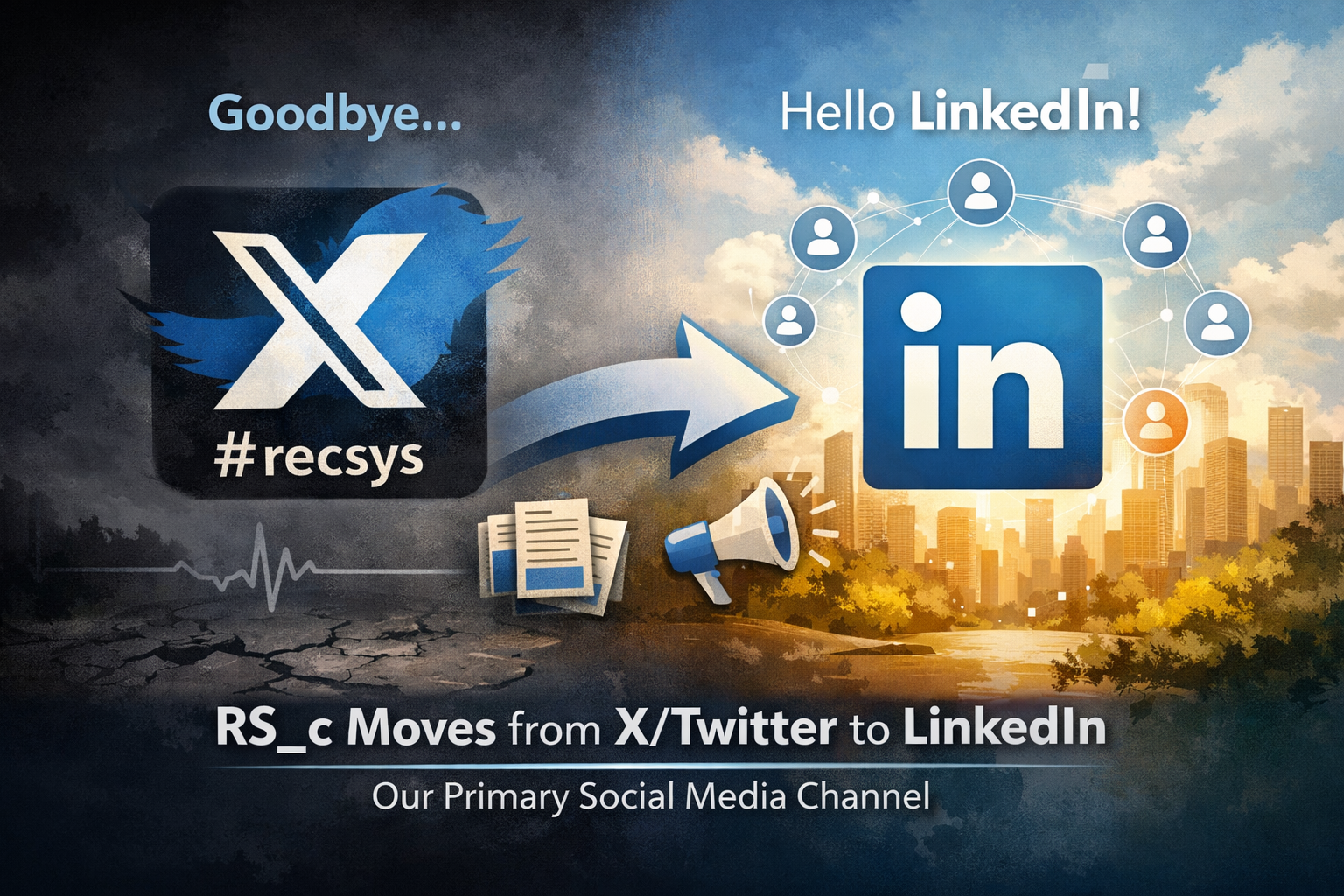
This is not because we suddenly prefer LinkedIn. Quite the opposite. If you asked us to pick a platform on product design alone, we would still pick the old Twitter experience. Short posts are a feature, not a bug. The conversational norms were closer to “lab meeting” than “career fair”. And the open graph made it easy to bump into adjacent subfields—IR folks, HCI folks, causal folks—without needing an invitation.
But the thing that counts is where the people are. And our own micro-signals point in the same direction. RS_c’s X account is still there, with 778 followers and a long posting history, yet recent #recsys-tagged posts show engagement counts that rarely escape the low single digits. That is not a scientific study, but it matches what many of us feel day to day: the marginal value of posting to X has dropped.
There is also a structural problem: X has made “casual reading” harder. Over the past years, the platform has increasingly restricted what non-logged-in users can view, pushing people into sign-in walls and limiting anonymous browsing. Even the surrounding ecosystem that once helped discovery has frayed; hashtag-based thread aggregations that used to make niche topics easier to follow now look dated and incomplete. When a community’s discovery mechanisms degrade, niche hashtags are often the first casualty.
Meanwhile, LinkedIn has become the place where many researchers and practitioners actually maintain their professional presence. It is not perfect. Ironically, LinkedIn’s recommender system is probably one of the worst in the industry. It frequently happens that weeks-old posts are shown in the stream that one has already seen and even liked. Still, reach matters, and LinkedIn reach is currently real.
We are also not the first to make this move. In late 2025, RS_c covered how ACM TORS shifted its social activity from X to LinkedIn, explicitly framing it as a response to where scholarly attention is flowing. That story resonated because it mirrors what many technical communities are quietly doing: keeping an X account alive, but moving the center of gravity elsewhere (disclaimer: ACM TORS social media activity and RS_c are managed by the same person).
Concretely, RS_c’s plan is simple. New blog posts will be announced on LinkedIn. Short updates—paper acceptances, datasets, notable industry deployments, CFP reminders—will increasingly show up there as well. X will not be deleted, and we may still cross-post occasionally, but LinkedIn is where we will put the consistent effort.
There is a final meta-point here, and it is a recommender-systems point. Platform choice is not just “where to post.” It is also “which recommender system do you want mediating your work.” X and LinkedIn optimize for different behaviors, different networks, and different feedback loops. Our move is, in a small way, a reminder that recommender systems do not only recommend content. They shape where communities form, how fields talk to themselves, and which ideas get repeated enough to become “common knowledge.” If #recsys feels dead on X, that is not just a hashtag problem. It is a distribution problem. And distribution, as we all know, is half the system.
How Nvidia spams the Twitter #RecSys feed
‘Recsperts’ releases its 20th episode; This time on Practical Bandids and Travel Recommendations
Austria is the country with the highest number of top (female) RecSys researchers
About The Author

Joeran Beel
I am the founder of Recommender-Systems.com and head of the Intelligent Systems Group (ISG) at the University of Siegen, Germany https://isg.beel.org. We conduct research in recommender-systems (RecSys), personalization and information retrieval (IR) as well as on automated machine learning (AutoML), meta-learning and algorithm selection. Domains we are particularly interested in include smart places, eHealth, manufacturing (industry 4.0), mobility, visual computing, and digital libraries. We founded or maintain, among others, LensKit-Auto, Darwin & Goliath, Mr. DLib, and Docear, each with thousand of users; we contributed to TensorFlow, JabRef and others; and we developed the first prototypes of automated recommender systems (AutoSurprise and Auto-CaseRec) and Federated Meta Learning (FMLearn Server and Client).