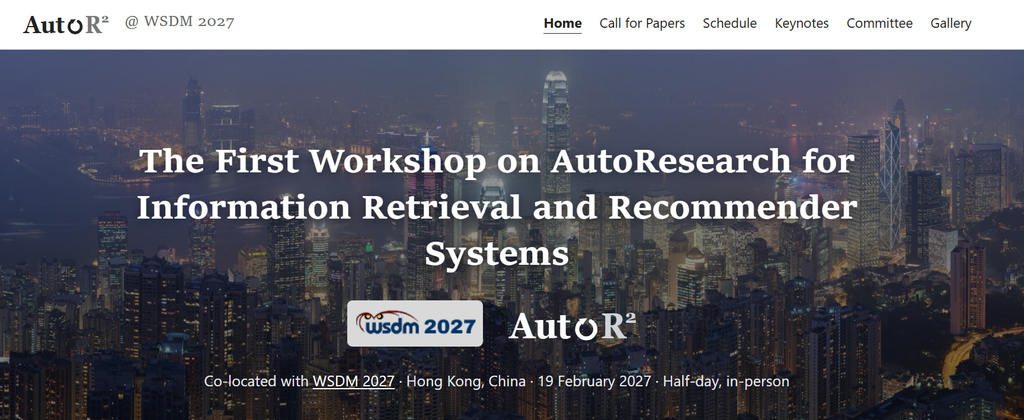
The First Workshop on AutoResearch for Information Retrieval and Recommender Systems (AutoR²)
I have been saying for two years that research automation is the topic our community should be working on, and that we are late to it. So I was happy to see this: the First Workshop on AutoResearch for Information Retrieval and Recommender Systems (AutoR²) will be held at WSDM 2027 in Hong Kong on 19 February 2027. The submission deadline is 30 November 2026. That is three weeks from now. If you have something in a drawer, this is the venue for it.
Why I think this is the topic for RecSys and IR
My own work has circled this question since 2025. With Min-Yen Kan and Moritz Baumgart, I evaluated Sakana’s AI Scientist and found it badly flawed and remarkable at the same time: five of its twelve proposed experiments failed on coding errors, several manuscripts contained hallucinated numbers, and a complete paper still cost $6 to $15 and 3.5 hours of human time. We then built AutoRecLab, an autonomous RecSys lab that translates natural-language research tasks into executable experiments, and presented it at RecSys 2026. In our FRAME’26 position paper, we called on the community to build, evaluate, and govern such systems now, rather than once they are routine.
My position has not softened since. Once an agent can design, run, and write up a RecSys experiment for $20, several questions we currently argue about change at the same time. Which baselines count. Which splits are defensible. Which metrics support which claim. How reproducibility is established, and how much reviewing capacity the community has left. That is why I rank AutoResearch ahead of sequential recommendation, fairness, or LLM-based recommenders right now. Those lines of work continue. How they get carried out is what changes.
RecSys and IR are also good testbeds for research automation. Our experiments are cheap, they run on public data, and they fail in ways a human can inspect. Our methodological traps are the interesting ones for this question too. Implicit feedback, exposure, candidate construction, and temporal leakage are exactly the places where an agent executes its code correctly and still answers the wrong question. In our own AutoRecLab runs, eight of nine produced code we classified as bug-free, and successful execution still did not give us a scientifically meaningful analysis.
That is the kind of question a workshop can move further than another round of single-group papers. So: overdue, and I am glad someone built it.
What AutoR² covers
The organizers want IR, RecSys, AutoML, AI agents, self-evolving systems, AI4Science, and industrial ML researchers in one room, to work out the scope, capabilities, and limits of AutoResearch for our field. The call for papers lists six themes:
- The concept and applicability of AutoResearch for IR and RecSys, including which retrieval, ranking, and recommendation problems are suitable
- Methodology: research planning for multi-stage pipelines, learning from prior research experience, and the human role in offline and online loops
- AutoResearch-driven development, from data and representations to model architecture, ranking, and online strategy iteration
- Infrastructure: benchmarks, executable research environments, and safe access to data, compute, and production systems
- Evaluation of generated methods and findings, and of the research agents themselves
- What IR and RecSys can contribute to automated scientific discovery more generally
Dates, format, and submission
AutoR² is a half-day, in-person workshop at the Cordis in Mong Kok, Hong Kong.
- Submission: 30 November 2026 (AoE)
- Notification: 18 December 2026
- Workshop: 19 February 2027
The workshop accepts research, position, demo, and opinion papers of up to five pages including references, in anonymized ACM sigconf format, as PDF via Microsoft CMT. Review is double-blind. Accepted papers appear in the WSDM 2027 Companion Proceedings, with an opt-out for authors who prefer to stay out, and they have to be presented onsite.
The organizers are Yingchen Zhang and Ruqing Zhang (Institute of Computing Technology, Chinese Academy of Sciences), Mingwei Zhang and Zhaochun Ren (Leiden University), and Ming Li, Andy Wang, and Yinglong Xia (Meta). Lizhu Zhang from Meta is the first confirmed keynote speaker, with more to be announced.

12th Italian Information Retrieval Workshop (IIR 2022)
HealthRec@RecSys2020: 5th Workshop on Health Recommender Systems

RecSys Workshops at SIGIR 2024
About The Author

Joeran Beel
I am the founder of Recommender-Systems.com and head of the Intelligent Systems Group (ISG) at the University of Siegen, Germany https://isg.beel.org. We conduct research in recommender-systems (RecSys), personalization and information retrieval (IR) as well as on automated machine learning (AutoML), meta-learning and algorithm selection. Domains we are particularly interested in include smart places, eHealth, manufacturing (industry 4.0), mobility, visual computing, and digital libraries. We founded or maintain, among others, LensKit-Auto, Darwin & Goliath, Mr. DLib, and Docear, each with thousand of users; we contributed to TensorFlow, JabRef and others; and we developed the first prototypes of automated recommender systems (AutoSurprise and Auto-CaseRec) and Federated Meta Learning (FMLearn Server and Client).