ACM UMAP conference now A-ranked: What does it mean for the RecSys community?
ACM UMAP just got an upgrade that many academics quietly care about. The UMAP 2026 website states that the conference is ranked A (“Excellent”) in the ICORE 2026 rankings. For anyone who has ever had to translate “this venue is great” into committee-speak, an A label is a very usable sentence.
In the CORE/ICORE ecosystem, “A” is literally defined as an excellent, highly respected venue, while “A*” is reserved for flagship conferences in a discipline area. The ICORE initiative also reflects a broader, more international collaboration around rankings than CORE used to be on its own. It still is a blunt instrument, but it is a blunt instrument that many institutions use.
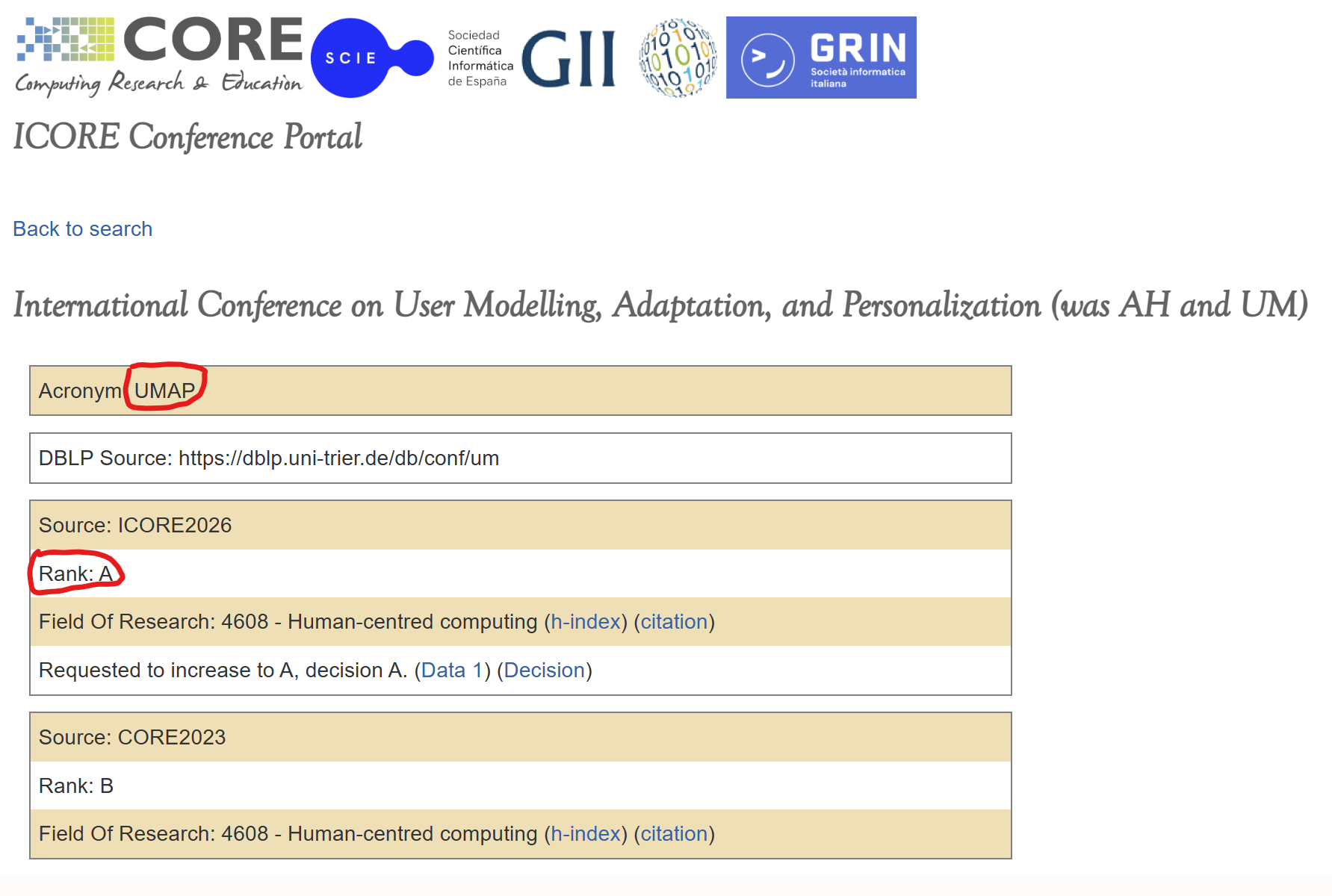
The UMAP upgrade is more interesting than it might appear on first glance. It fits a pattern the recommender-systems community has watched in real time. A few years ago, the ACM RecSys Conference Series made the jump to an A conference in the CORE ranking. Even ACM’s announcement for the Transactions on Recommender Systems (TORS) pointed to that elevation as a signal that the field is maturing and growing. Put differently, the UMAP update feels less like a one-off correction and more like a trend: personalization research is increasingly treated as “core” computing work.
UMAP’s history makes that recognition easy to justify. The roots go back to the first International Workshop on User Modeling in 1986, and then continue through the long-running User Modeling (UM) and Adaptive Hypermedia (AH) conference series. In 2009, UM and AH were merged into what we now call UMAP. Since then, the series has built a consistent identity around user modeling, adaptation, personalization, and the human-facing consequences of all three.
The past-conferences list reads like a compact travel diary of personalization research. You can see recent editions such as UMAP 2024 in Cagliari and UMAP 2023 in Limassol, plus the online and hybrid years that everyone remembers a little too well. That continuity matters. It is hard to build a community if your “home venue” keeps changing what it is.
Looking ahead, UMAP 2026 will be held in Gothenburg, Sweden, June 8–11, 2026, and it is planned as an in-person event. The conference explicitly frames itself as a meeting point between AI and HCI, and that framing is not cosmetic. For the recommender-systems community, UMAP’s relevance is almost embarrassingly direct. Recommenders are often user models with an interface and a feedback loop. They are also societal systems now, so questions about transparency, user control, fairness, and evaluation are not “nice extras” anymore. UMAP has a long tradition of treating these topics as first-class research problems, not as an appendix after you report NDCG. Not to mention that ACM UMAP 2026 in Gothenburg is organized by some of the most notable recommender-systems researchers in the world. So, the focus of ACM UMAP this year seems pretty clear.
At the same time, let’s keep the hierarchy clear. For research that is squarely about recommender systems, ACM RecSys remains the obvious first-choice conference. And for journal work, ACM TORS is the dedicated ACM journal that is explicitly built to cover the full spectrum, from algorithms to user experience to societal impact. Those two outlets still define the center of gravity for RecSys research.
But UMAP matters because it changes who you talk to, and how. You will meet many people there that you also find at ACM RecSys. You will also meet people who bring valuable insights from slightly different angles, including classic user modeling, HCI evaluation culture, and personalization problems that are not always phrased as “top-N ranking”. That perspective shift is not a side benefit. It is often where the next good idea comes from.
Now add the ACM SIGIR conferences to this picture, and the story gets even more interesting. SIGIR is broader in scope than RecSys and UMAP, but it has traditionally had the strongest ranking label in this trio, often discussed as A* in CORE-style rankings. More importantly for our community, SIGIR has been steadily turning into a major recommender-systems venue in practice, not just on paper. In 2020, “recommendation” was reported as the most common term across SIGIR papers, which was already a hint that the center of mass was shifting. By SIGIR 2022, RS_c counted 115 accepted papers (including posters, etc.) that were related to recommender systems, based on titles alone.
The other venue that deserves an explicit mention here is The ACM Web Conference (WWW), also A* ranked according to CORE. WWW is broader than RecSys, UMAP and SIGIR, but it has become a very natural home for recommender-systems work because so much of modern recommendation is, in practice, a web-scale problem: user behavior on platforms, ranking under feedback, multimodal content, and the messy reality of evaluation in the wild. In the 2025 proceedings, you can see recommender systems showing up very directly, for example in papers on multimodal sequential recommendation with (vision-)LLMs, robustness and distillation for multimodal recommenders, and LLMs as “narrative-driven” recommenders. For RecSys researchers, WWW is valuable precisely because it forces our community to engage with adjacent experts in information retrieval, web mining, computational social science, and responsible online systems, where the next generation of recommendation ideas and concerns first becomes visible.
So here is the new, slightly awkward reality. The RecSys community now has the choice: The obvious venue, ACM RecSys, with an A ranking. Or UMAP, also A. And we have SIGIR and WWW, which are broader but the premier venues in the broader IR, RecSys and Web community that many researchers and hiring and promotion committees instinctively recognise. It is great news that RecSys gains so much traction and that we can point to (at least) four “A-or-better” homes for relevant work. But, it also means something else: the best RecSys work may get more splattered across venues, simply because authors can now optimize for slightly different audiences and incentives.
This raises a question we floated a few years ago, back when the SIGIR trend became impossible to ignore. Is it time for a joint ACM SIGIR, RecSys (and now UMAP) conference, and possibly parts of The ACM Web Conference , or at least a tighter co-location strategy that makes cross-community exchange the default rather than the exception? It is not an easy idea. It involves governance, sponsorships, reviewing cultures, and the practical reality that conferences are also social ecosystems. But if the field keeps expanding across neighboring flagships, the cost of fragmentation will grow too, and we should at least keep the “one big tent” option on the table.


Call for Papers for ACM RecSys 2026: No LBR but R&P Notes + ‘Past, present and future papers’

Call for Papers (CfP) of the 16th ACM Conference on Recommender Systems (ACM RecSys 2022)
The Web Conference 2023 requires at least one full non-student registration for accepted papers, even for students.
About The Author

Joeran Beel
I am the founder of Recommender-Systems.com and head of the Intelligent Systems Group (ISG) at the University of Siegen, Germany https://isg.beel.org. We conduct research in recommender-systems (RecSys), personalization and information retrieval (IR) as well as on automated machine learning (AutoML), meta-learning and algorithm selection. Domains we are particularly interested in include smart places, eHealth, manufacturing (industry 4.0), mobility, visual computing, and digital libraries. We founded or maintain, among others, LensKit-Auto, Darwin & Goliath, Mr. DLib, and Docear, each with thousand of users; we contributed to TensorFlow, JabRef and others; and we developed the first prototypes of automated recommender systems (AutoSurprise and Auto-CaseRec) and Federated Meta Learning (FMLearn Server and Client).