
Who Runs ACM RecSys? From 11 to 50+ Chairs in Twenty Years
Most conference statistics count papers, citations, acceptance rates, or attendees. I counted something else: the number of people who make the ACM Conference on Recommender Systems (ACM RecSys) happen.
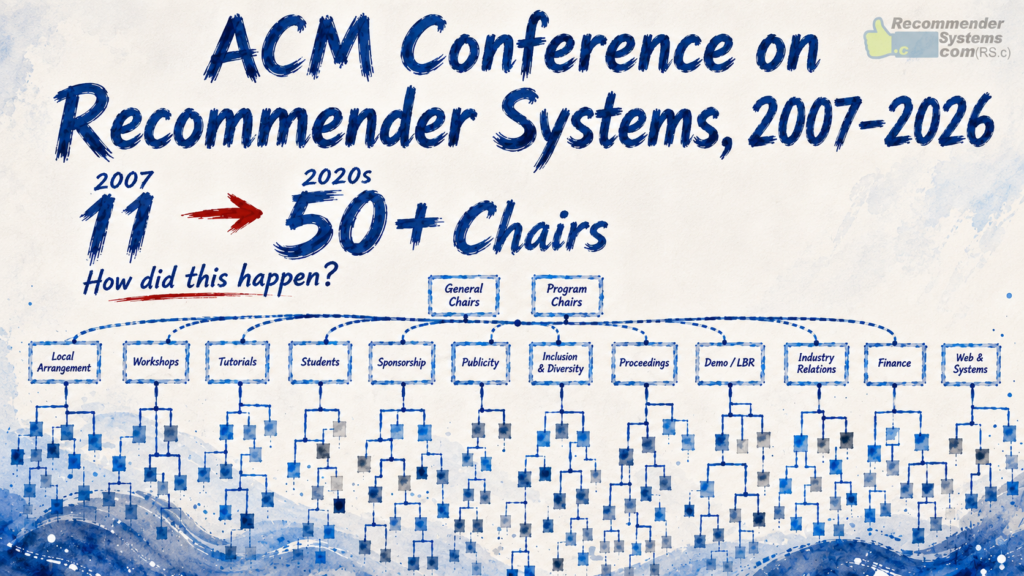
The first ACM RecSys in 2007 was organised by eleven Chairs. Seventeen years later, the 2024 organising page listed 56 names; 2026 it’s almost as many. The set of named responsibilities had grown too, but nowhere near as fast.
I reconstructed the annual ACM RecSys organising committees from surviving conference websites and committee pages. The dataset holds 568 recorded roles, spread across 289 people who have held at least one recorded ACM RecSys chair position.
The data shows more than a conference adding Chairs as it grew. ACM RecSys made more kinds of work visible, and more recently it put teams behind responsibilities that one or two people used to handle alone. It also recruits new organisers in large numbers while keeping more of them from one edition to the next.
Disclosure: I am in the dataset. I hold one recorded ACM RecSys chair role, as General Co-Chair of the 2027 edition, and I sit on the current ACM RecSys Steering Committee. I keep myself out of the examples below, but I appear in both sources used here.
The conference became much bigger to organise
The first ACM RecSys in 2007 had eleven recorded chair positions covering eight types of responsibility. By 2019, there were 28 positions across fifteen role types.
Then the count rose quickly: 38 in 2020, 40 in 2021, 43 in 2022, 49 in 2023, and 56 in 2024. It has fallen since, to 52 in 2025 and 43 in 2026.
| Year | Recorded chair positions | Distinct role types |
|---|---|---|
| 2007 | 11 | 8 |
| 2019 | 28 | 15 |
| 2020 | 38 | 17 |
| 2021 | 40 | 17 |
| 2022 | 43 | 17 |
| 2023 | 49 | 18 |
| 2024 | 56 | 18 |
| 2025 | 52 | 18 |
| 2026 | 43 | 17 |
The first five editions, from 2007 through 2011, averaged 14 recorded chair positions per year. The five editions from 2022 through 2026 average 48.6, roughly three and a half times as many.
The 2024 peak owes something to an unusually large team of six Local Chairs. Drop Local Chairs entirely and the increase still runs from 27 positions in 2019 to 50 in 2024.
Nor does the growth come from a few people collecting several titles in one edition. Across twenty editions from 2007 through 2026, only six cases occur in which one person holds two recorded chair positions in the same year. In 2024, all 56 positions were held by 56 different people.
The conference grew mainly by involving more people.
Isn’t this simply because the conference grew?
The obvious objection is that larger conferences need larger committees.
More submissions mean more programme work. More attendees mean more registration, local organisation, student support, sponsorship, communication, and accessibility work. If ACM RecSys grew substantially, a larger organising committee is exactly what one would expect.
The chair dataset cannot separate these effects. I have no comparable twenty-year series for submissions, attendance, budget, or workload.
What it can show is the form the organisational response took. The General and Program Chair layer did not expand in proportion to the rest. Named responsibilities increased, but far more slowly than people. And in recent years, much of the expansion came from putting several people on responsibilities that already existed.
Scale is almost certainly part of the explanation. It does not explain why scale was accommodated in this particular way.
A comparison with SIGIR, UMAP, or CIKM would help, but this dataset cannot provide one. For those conferences I collected roles only for people who also appear in the ACM RecSys population, so their annual committees are incomplete.
More responsibilities became visible
The first ACM RecSys already had a broad organising structure. Joseph A. Konstan was General Chair, with John Riedl and Barry Smyth as Research Program Co-Chairs. Francesco Ricci and Loren Terveen handled the doctoral programme. Francisco J. Martin was responsible for industry, Alison Baerwald for local organisation, and Alexander Felfernig for liaison, Cliff Lampe for finance and registration, and Pearl Pu for short papers.
Eight types of responsibility were visible in that first edition. Others appeared later.
| First year visible | Role | First recorded Chair(s) |
|---|---|---|
| 2008 | Publicity | Lorraine McGinty |
| 2009 | Workshops | Joseph A. Konstan; Sean McNee |
| 2010 | Tutorials | Francesco Ricci |
| 2010 | Web/Media | Chris Barklem |
| 2012 | Demo/LBR | Elizabeth M. Daly; Michael Ekstrand |
| 2014 | Proceedings | Bart Knijnenburg |
| 2016 | Social | Casey Dugan |
| 2016 | Students | Amy Zhang; Bart Knijnenburg |
| 2017 | Sponsorship | Puya Vahabi |
| 2018 | Inclusion & Accessibility | Humberto Corona |
| 2019 | Challenge/Cup | Farshad Bakhshandegan Moghaddam; Peter Knees; Yashar Deldjoo |
| 2020 | Reproducibility | Alan Said; Paolo Cremonesi |
| 2021 | Women’s Events | Hanna Hauptmann; Julia Neidhardt; Özlem Özgöbek |
The year a title first appears is not the year the work began. Students attended ACM RecSys before there was a Student Chair. Somebody maintained the website before that job had a stable name. The table records when responsibilities became explicit in the surviving organisational structure.
The organisation developed a broader vocabulary for its own work. Tutorials, workshops, demos, and proceedings became explicit responsibilities, and so did students, sponsorship, inclusion, reproducibility, Women’s Events, and the Challenge.
Some early titles disappeared again. Short Paper Chairs occur only in 2007 and 2008. Liaison roles continue for several years and then largely vanish from the record. A Social Chair appears only intermittently. Other responsibilities became stable features of the annual organisation.
Five of the eight role types visible in 2007 are still represented in 2026: General, Program, Doctoral, Industry, and Finance/Registration.
The chair titles are therefore also a small institutional history of what ACM RecSys came to regard as work worth naming.
Recent growth is increasingly about co-chairing
In 2019, 28 recorded positions were spread across fifteen role types. In 2024, 56 positions were spread across eighteen.
Positions doubled while role types grew by a fifth. The mean number of Chairs per role type rose from 1.87 to 3.11.
This is not the work of one unusually large responsibility. The median rose from two Chairs per role type in 2019 to three in 2024.
| 2019 | 2024 | |
|---|---|---|
| Chair positions | 28 | 56 |
| Role types | 15 | 18 |
| Mean Chairs per role type | 1.87 | 3.11 |
| Median Chairs per role type | 2 | 3 |
| Role types with at least 3 Chairs | 2 of 15 | 14 of 18 |
| Largest team for one role | 3 | 6 |
In 2019, only two of fifteen responsibilities had three Chairs and none had more. In 2024, fourteen of eighteen had at least three. Local organisation had six people; Sponsorship, Demo/LBR, Reproducibility, and Women’s Events had four each.
Remove the six-person Local team and the 2024 median is still three Chairs per role type.
Of the 28 positions added between 2019 and 2024, only eight belong to responsibilities introduced after 2019 and still present in 2024: four Reproducibility Chairs and four Women’s Events Chairs. The other twenty went to responsibilities that already existed.
| Established responsibility | 2019 Chairs | 2024 Chairs |
|---|---|---|
| Local | 1 | 6 |
| Sponsorship | 1 | 4 |
| Demo/LBR | 2 | 4 |
| Proceedings | 1 | 3 |
| Doctoral | 2 | 3 |
| Inclusion & Accessibility | 2 | 3 |
| Publicity | 2 | 3 |
| Students | 2 | 3 |
| Tutorials | 2 | 3 |
| Workshops | 2 | 3 |
Recent expansion is therefore largely a story of co-chairing. ACM RecSys added responsibilities throughout its history, but much of the recent growth came from spreading established ones across larger teams.
Even if the underlying work simply grew, the response was structural. One person handling proceedings decides alone and carries the knowledge alone. Three people handling proceedings have to agree — and two of them can still do it next year if the third stops.
The top stayed comparatively small
General and Program Chair teams grew much less than the rest of the organisation.
From 2007 through 2011, 19 of 70 recorded positions were General or Program Chair positions: 27.1%.
From 2022 through 2026, it is 25 of 243: 10.3%.
| Period | General + Program Chairs | All positions | Share |
|---|---|---|---|
| 2007–2011 | 19 | 70 | 27.1% |
| 2022–2026 | 25 | 243 | 10.3% |
The first five editions averaged 3.8 General and Program Chairs per year. The most recent five average 5.0. Over the same comparison, the organisation as a whole went from an average of 14 positions to 48.6.
In 2007, Konstan, Riedl, and Smyth accounted for three of eleven recorded positions. In 2024, two General Chairs and two Program Chairs accounted for four of 56.
Scientific-programme leadership and overall responsibility stayed with relatively few people while much more organisational work accumulated around them.
That covers the organisation. What about the people in it?
Most people do it once
Of the 289 people with at least one recorded ACM RecSys chair position, 180 appear exactly once. That is 62.3%.
Another 41 people appear twice and 23 appear three times. Only 25 people have at least five roles, and just 16 have more than five.
| Recorded ACM RecSys roles | People | Share |
|---|---|---|
| 1 | 180 | 62.3% |
| 2 | 41 | 14.2% |
| 3 | 23 | 8.0% |
| 4 | 20 | 6.9% |
| 5 | 9 | 3.1% |
| More than 5 | 16 | 5.5% |
| Total | 289 | 100% |
The 109 people who return for at least a second role are 37.7% of the dataset but hold 68.3% of all recorded ACM RecSys chair positions. The 25 people with at least five roles are 8.7% of the population and hold 27.6% of all positions.
Only 24 of the 289 people appear as Chairs in at least five different ACM RecSys editions. Li Chen appears in eleven editions between 2010 and 2026, Alan Said in nine, and Sole Pera and Benedikt Loepp in eight each.
For most researchers, organising ACM RecSys is a one-off contribution. A much smaller group returns again and again.
Does the same group keep coming back?
Measuring this requires care because ACM RecSys gets older every year.
At the first conference in 2007, recruiting somebody with previous ACM RecSys chair experience was literally impossible. In 2008, the entire pool was the eleven people recorded in 2007. By 2026, the conference could draw on almost two decades of former organisers.
Asking whether somebody has “ever served before” therefore builds the age of the conference into the statistic.
The raw measure rises accordingly. Across 2008–2012, 35.1% of annual organiser observations had appeared previously. The corresponding figures are 43.4% for 2013–2018 and 54.8% for 2019–2026.
A cleaner measure asks what proportion of one year’s organisers return immediately in the next edition. Across the transitions ending in 2008 through 2012, the average is 23.9%. During 2013–2018, it falls to 17.9%. From 2019 through 2026, it rises to 39.2%.
We can also divide each annual committee into first-time organisers, people continuing directly from the previous year, and previous organisers returning after a gap.
| Period | First-time Chairs | Continued from previous year | Returned after a gap |
|---|---|---|---|
| 2008–2012 | 64.9% | 21.6% | 13.5% |
| 2013–2018 | 56.6% | 17.1% | 26.4% |
| 2019–2026 | 45.2% | 37.1% | 17.7% |
Recent ACM RecSys is not simply run by the same population. First-time Chairs still account for 45.2% of organiser observations during 2019–2026, and in 2024 alone, 26 of the 56 organisers were serving as ACM RecSys Chairs for the first time.
The 2025 committee shows much stronger immediate continuity. Twenty-nine of the 56 people who organised in 2024 appeared again in 2025, making up 56.9% of the 51 distinct organisers that year. Twenty-one of those 51 returned again in 2026.
Giving every new organiser the same five-year window to return provides another comparison.
| First chair role | New organisers | Returned within five years | Return rate |
|---|---|---|---|
| 2007–2011 | 52 | 22 | 42.3% |
| 2012–2016 | 56 | 13 | 23.2% |
| 2017–2021 | 81 | 36 | 44.4% |
The early conferences already had a reasonably persistent organising population. The return rate fell substantially for people entering during 2012–2016 and rose again among those entering from 2017 onwards.
Most people still serve only once. But recent editions combine a large intake of newcomers with far more immediate continuity than the middle period of ACM RecSys history.
Where do General Chairs come from?
The share of General Chairs with previous ACM RecSys organisational experience also rises over time.
Among the ten General Chair appointments from 2007 through 2012, three had previously held another recorded ACM RecSys chair role. Among the thirteen appointments during 2013–2018, five had. Since 2019, fourteen of 21 General Chair appointments have gone to people with earlier ACM RecSys chair service.
| Period | General Chairs with any earlier ACM RecSys role | With ACM RecSys role in preceding five years |
|---|---|---|
| 2007–2012 | 30.0% | 30.0% |
| 2013–2018 | 38.5% | 38.5% |
| 2019–2026 | 66.7% | 42.9% |
The first column carries the age effect described above: a mature conference has many more former organisers available.
Restricting the comparison to service during the preceding five years produces a much smaller change: from 38.5% during 2013–2018 to 42.9% since 2019.
What has clearly changed is the depth of organisational history behind recent leadership.
Tommaso Di Noia became Program Chair in 2023 and General Chair in 2024. Humberto Corona first appears in Inclusion & Accessibility in 2018 and becomes General Chair in 2021. Alan Said first appears in Publicity in 2012 and becomes General Chair seven years later.
Li Chen’s recorded history starts with Liaison in 2010. After local organisation, demos, tutorials, and Program Chair in 2020, she becomes General Chair in 2023. Gediminas Adomavicius and George Karypis return as General Chairs in 2026 after organisational histories stretching back to 2011 and 2013.
Among the fourteen recent General Chair appointments with earlier ACM RecSys service, the median interval from first recorded chair position to General Chair is seven years. That figure cannot sensibly be compared with the first editions, when ten years of previous ACM RecSys experience were impossible.
Program Chair is only one route into overall conference leadership. Of the 43 people who had become ACM RecSys General Chair by 2026, only ten had previously been Program Chair.
Other routes run through doctoral activities, workshops, industry, inclusion, publicity, and the rest of the organisation.
Continuity takes different forms
Repeated service is not the same as climbing a leadership hierarchy.
Benedikt Loepp has the longest uninterrupted sequence of one person holding the same recorded ACM RecSys role: six consecutive years as Web/Media Chair from 2015 through 2020.
Özlem Özgöbek served four consecutive years as Women’s Events Chair from 2021 through 2024. Abhishek Srivastava worked on the ACM RecSys Challenge from 2022 through 2025. Saikishore Kalloori has handled Finance and Registration from 2023 through 2026.
These are records of specialisation, not unfinished journeys towards General Chair.
Hanna Hauptmann shows another problem with simple counts. Only six times in twenty editions does one person hold two recorded ACM RecSys chair roles in the same year, and Hauptmann accounts for three of them, handling Women’s Events and Publicity simultaneously in 2021, 2022, and 2023.
Her six positions therefore fit into three editions.
Joseph A. Konstan also has six recorded ACM RecSys positions. His span nineteen years, from General Chair of the first conference in 2007 to General Chair again in 2026.
The spreadsheet gives both records the number six.
Long gaps produce yet another pattern. George Karypis was Program Chair in 2013 and then disappears from the annual organising pages for twelve editions, reappearing in 2026 as General Chair. No year-to-year retention statistic can see that.
Gediminas Adomavicius and Markus Zanker both last appeared in 2015 before returning in 2026. Alexander Tuzhilin’s recorded service begins as General Chair in 2009, includes Program Chair in 2017, and resumes with a Doctoral Chair position in 2026.
Konstan has the longest span between first and last recorded roles: nineteen years. Tuzhilin spans seventeen; Chen and Zanker each sixteen.
Twenty years later
Fifty-two different people held at least one recorded ACM RecSys chair position during the first five editions, from 2007 through 2011.
Only eight of them reappear as annual Chairs during the most recent five editions, from 2022 through 2026: Gediminas Adomavicius, Dietmar Jannach, Joseph A. Konstan, Li Chen, Markus Zanker, Robin Burke, Shlomo Berkovsky, and Alexander Tuzhilin.
Eight out of 52 is 15.4%. Taken at face value, the annual organising pages therefore show substantial generational replacement.
The Steering Committee changes that picture.
The current ACM RecSys Steering Committee page lists 46 distinct people across its Chair, Executive Committee, and membership. Fifteen of the original 52 organisers are current members.
Eight are the same people who also reappear in recent annual committees. Seven others have no annual ACM RecSys chair role during 2022–2026 but remain current Steering Committee members: Bamshad Mobasher, Barry Smyth, Domonkos Tikk, Francesco Ricci, Ido Guy, Pearl Pu, and Werner Geyer.
Alexander Felfernig adds another case. His last annual chair role in the dataset is in 2014, but the Steering Committee history records him as a member through 2024.
If “still institutionally active during the last five years” means either holding an annual chair role during 2022–2026 or serving on the Steering Committee at some point during that period, sixteen of the original 52 qualify.
| View of continuity among the 2007–2011 organisers | People | Share |
|---|---|---|
| Annual ACM RecSys Chair during 2022–2026 | 8 | 15.4% |
| Annual Chair or Steering Committee activity during 2022–2026 | 16 | 30.8% |
The apparent continuity of the early cohort therefore doubles once the institutional layer around the annual conference is counted.
Barry Smyth is the clearest example. His annual ACM RecSys record consists of one position: Research Program Co-Chair of the first conference in 2007. He is nevertheless still a member of the Steering Committee.
The other 2007 Research Program Co-Chair, John Riedl, died in 2013 at the age of 51. A measure of who remains active twenty years later has no category for that.
Pearl Pu and Francesco Ricci both last appear in annual chair positions in 2017 and remain on the Steering Committee. Ido Guy and Werner Geyer last appear in annual committees in 2016 and remain members. Bamshad Mobasher has no annual position during 2022–2026, but he chaired the Steering Committee from 2020 through 2023 and is already announced as a General Chair for 2027.
The Steering Committee should not simply be added to the annual chair count. Annual committees show who is organising a particular edition; the Steering Committee is a different layer of responsibility, connecting editions to one another.
Konstan appears directly at both ends of the annual record, as General Chair in 2007 and again in 2026. Smyth connects the same two periods differently: one annual role ties him to the first scientific programme, and Steering Committee service ties that early history to the conference series today.
A mature conference can retain people institutionally long after their names disappear from the annual organising page.
A note on the data
This dataset is a best-effort historical reconstruction. Older conference websites disappear, some surviving pages are incomplete, role names change, and positions may be missing or classified inconsistently. Read the table as a reconstruction of visible service, not as indisputable ground truth.
Named roles also reflect documentation practice. The first appearance of a Student, Inclusion, or Reproducibility Chair tells us when the title becomes visible in the surviving record, not when somebody first did the underlying work.
Every chair position receives one count. General Chair, Program Chair, Web/Media Chair, Student Chair, and Finance/Registration Chair are numerically identical. The counts measure recurrence, not effort, seniority, prestige, or influence.
Announced future positions are included if they are already in the dataset. I stop the annual organisational analysis at 2026 because only three General Chair positions are currently represented for 2027; treating those as a complete committee would be misleading.
Any statistic based on whether somebody has “served before” is affected by the age of the conference. For comparisons across periods, I therefore place more weight on immediate retention and fixed return windows.
Finally, the conspicuous increase around 2019–2020 is a description, not an explanation. Its timing overlaps with the COVID-19 pandemic and precedes the CORE upgrade, but the chair table cannot establish why the change occurred.
From a conference to an institution
A larger organising committee is not automatically a better one. Co-chairing can spread workload, preserve expertise, and give more researchers a route into conference organisation. It can also raise coordination costs and blur responsibility. The chair table cannot tell us which effect dominates.
What it does show is a conference whose organisational form changed substantially. More responsibilities became explicit, established responsibilities moved to teams, and recent committees combine newcomers with a recurring organising population. Around all of that, the Steering Committee adds a further layer of continuity across editions.
The first ACM RecSys was organised around a new research conference. Twenty editions later, there is an organisational structure that persists beyond any individual year.
Twenty editions leave more behind than twenty organising committees.
They leave an institution.
I will publish the complete underlying table as part of this series. A second post, “Thank You for Your Service! Two Decades and 289 Chairs at ACM RecSys,” turns from the organisation to the people: who appears most often at ACM RecSys, who connects it to neighbouring conferences such as SIGIR and UMAP, and why identical role counts can mean very different kinds of service. Also, please note I made heavy use of ChatGPT to create this post.

Dr. Dr. Recommender Systems: Mounia Lalmas becomes an honorary doctor in Gothenburg

Joseph (‘Joe’) A. Konstan runs for the ACM presidency

‘Recsperts’ releases its 20th episode; This time on Practical Bandids and Travel Recommendations
About The Author

Joeran Beel
I am the founder of Recommender-Systems.com and head of the Intelligent Systems Group (ISG) at the University of Siegen, Germany https://isg.beel.org. We conduct research in recommender-systems (RecSys), personalization and information retrieval (IR) as well as on automated machine learning (AutoML), meta-learning and algorithm selection. Domains we are particularly interested in include smart places, eHealth, manufacturing (industry 4.0), mobility, visual computing, and digital libraries. We founded or maintain, among others, LensKit-Auto, Darwin & Goliath, Mr. DLib, and Docear, each with thousand of users; we contributed to TensorFlow, JabRef and others; and we developed the first prototypes of automated recommender systems (AutoSurprise and Auto-CaseRec) and Federated Meta Learning (FMLearn Server and Client).