ACM TORS enters Web of Science: another step in the journal’s maturation
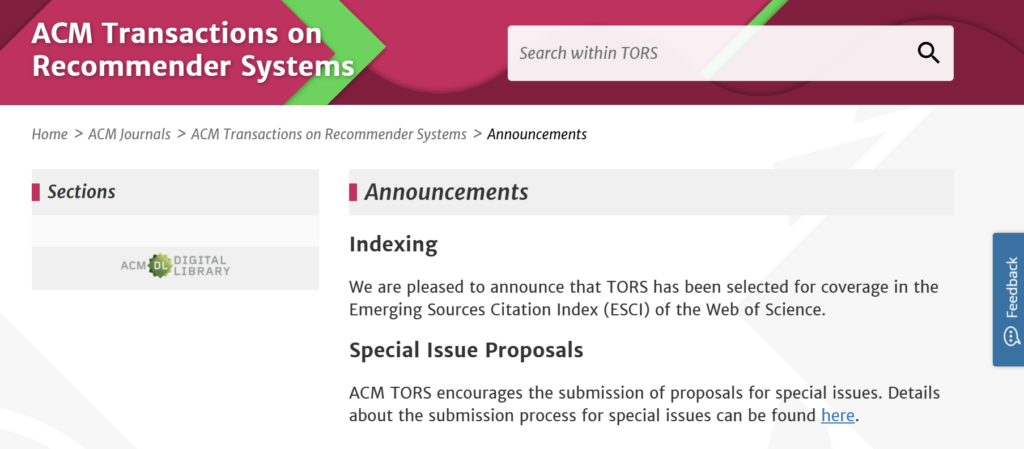
ACM Transactions on Recommender Systems has been selected for coverage in the Emerging Sources Citation Index of the Web of Science Core Collection. For a young journal, this is an important step. It means that ACM TORS is now part of one of the central citation infrastructures used by universities, libraries, funders, and evaluation committees.
This development follows other recent news. ACM TORS was recently included in the China Computer Federation ranking as a C-ranked journal in databases, data mining, and information retrieval. In addition, the journal introduced a new policy to strengthen reproducibility in offline evaluation. Taken together, these steps show a clear pattern: ACM TORS is becoming more visible, more established, and more demanding in its standards.
What Web of Science means
Web of Science is a curated citation database. Journals are selected according to editorial and quality criteria, including peer-review standards, publication regularity, international relevance, citation activity, and editorial transparency. The Emerging Sources Citation Index is often the first Web of Science entry point for newer or more specialized journals.
For ACM TORS, this matters because recommender systems is a field with a strong conference culture. A journal needs to justify its role by offering space for more complete, more reflective, and more reproducible work. Web of Science indexing helps authors because their articles become easier to find and easier to count in institutional evaluation systems. This is not the same as scientific quality, but it matters in academic practice.
The Impact Factor question
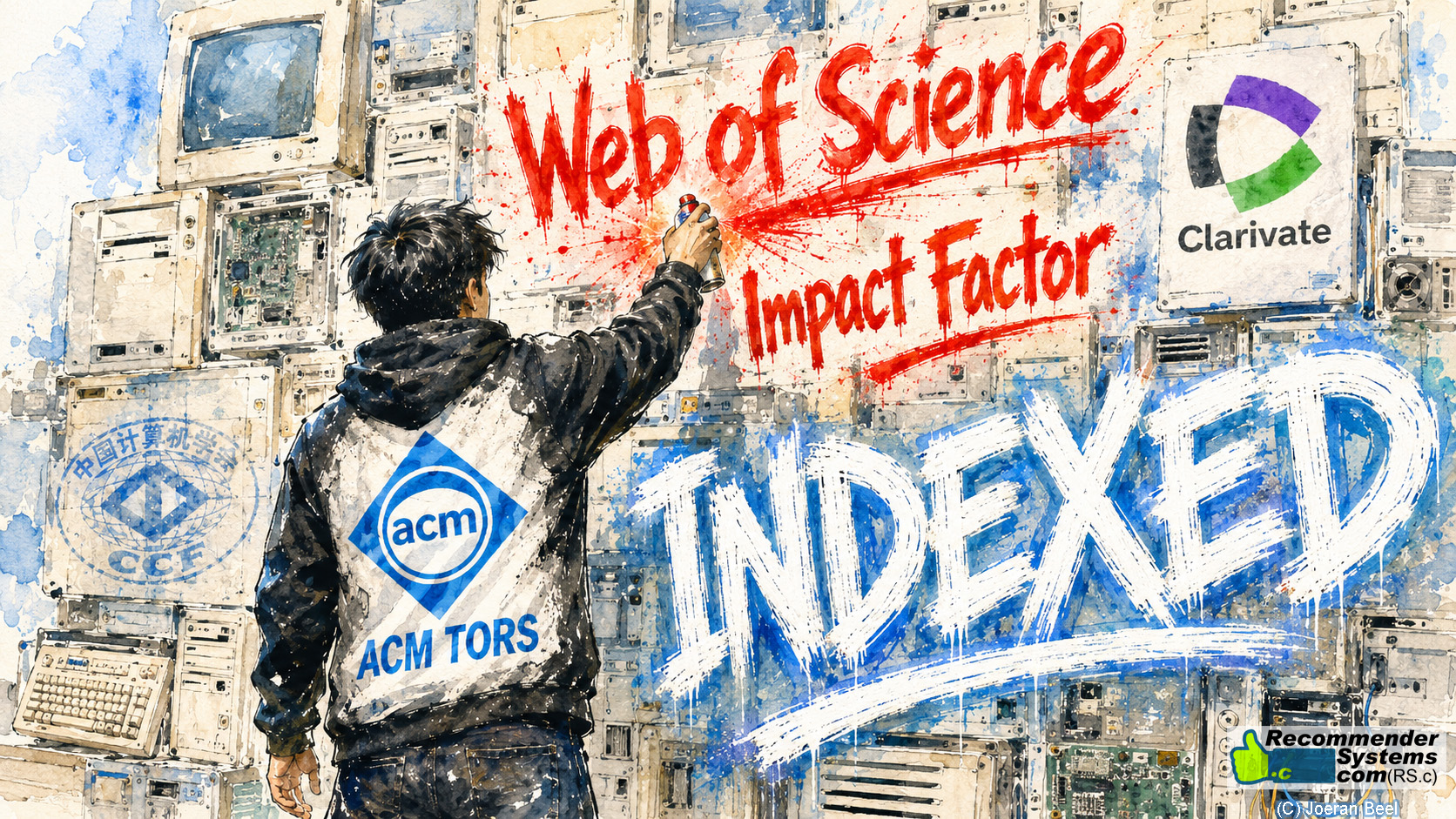
The natural next question is when ACM TORS will receive an Impact Factor.
A Journal Impact Factor measures how often articles from the previous two years are cited in a given year. For example, a future 2026 Impact Factor would count citations in 2026 to ACM TORS articles published in 2024 and 2025, divided by the number of citable articles from those two years.
A first Impact Factor for ACM TORS may become possible in the 2027 Journal Citation Reports, assuming that indexing and data processing proceed in time. A more conservative expectation would be 2028.
How high will it be? This cannot be predicted exactly. A first Impact Factor in the range of roughly 1.5 to 3.5 would be plausible for a young, specialized journal. Around 2 would already be a solid start. Above 3 would be a strong result. Even a lower number would still be useful, because many evaluation systems first ask whether a journal has an Impact Factor at all. A modest Impact Factor is therefore often better than no Impact Factor, especially for authors whose institutions rely on formal journal metrics.
Of course, the Impact Factor should not be confused with paper quality. It is a journal-level metric, not a judgment on individual articles. But it is widely used, and ignoring it does not make it disappear.
A journal gaining shape
The recent developments around ACM TORS are consistent. The CCF listing improves visibility in an important international research community. Web of Science indexing improves discoverability and prepares the journal for Journal Citation Reports. The new reproducibility policy strengthens the journal’s scientific profile.
For many researchers, this is not a theoretical matter. At many universities and in many countries, publishing in journals with an Impact Factor plays a direct role in hiring, promotion, tenure, PhD graduation requirements, and research funding. One may regret that academic careers are often shaped by such metrics. At the same time, universities and funding bodies do need some way to assess productivity and impact, even if no single number can do this fairly. For ACM TORS, an Impact Factor will therefore likely make the journal more attractive to authors who already value it scientifically, but who also need a publication venue that is recognized by their institutional evaluation systems. A likely consequence is more submissions. The task for the journal will be to turn this increased attention into higher selectivity and stronger papers, not simply into a larger editorial workload.
This is exactly the kind of development one would hope to see for a young ACM journal. ACM TORS is not only growing; it is becoming part of the formal infrastructure of the field. For authors, reviewers, editors, and readers in recommender systems, this is good news.
In restrained academic language: ACM TORS is developing rather well.

Where extra complexity pays off: five “Just Accepted” papers in ACM TORS

ACM TORS: “Just Accepted” in Summer / Autum 2025

When Defaults Become Research Questions: 10 New ACM TORS Papers
About The Author

Joeran Beel
I am the founder of Recommender-Systems.com and head of the Intelligent Systems Group (ISG) at the University of Siegen, Germany https://isg.beel.org. We conduct research in recommender-systems (RecSys), personalization and information retrieval (IR) as well as on automated machine learning (AutoML), meta-learning and algorithm selection. Domains we are particularly interested in include smart places, eHealth, manufacturing (industry 4.0), mobility, visual computing, and digital libraries. We founded or maintain, among others, LensKit-Auto, Darwin & Goliath, Mr. DLib, and Docear, each with thousand of users; we contributed to TensorFlow, JabRef and others; and we developed the first prototypes of automated recommender systems (AutoSurprise and Auto-CaseRec) and Federated Meta Learning (FMLearn Server and Client).