
Spotify and its recommender system has landed inside ChatGPT (for some)
From October 6, 2025, both Free and Premium listeners can connect their accounts and ask for songs, albums, playlists, or podcast episodes directly in a ChatGPT conversation. Mention “Spotify” in your prompt, authorize the link on first use, and the chat returns personalized picks you can tap to open in the Spotify app. The feature launches in English across 145 countries on web and mobile. Spotify stresses it’s opt-in, and says it won’t share audio or video from its catalog with OpenAI for training. (Spotify)
Under the hood, this is part of OpenAI’s new “apps in ChatGPT” platform. At DevDay, OpenAI positioned these integrations as chat-native apps, with Spotify in the first wave alongside Booking.com, Canva, Figma, Zillow and others. The idea is that ChatGPT orchestrates tasks while partner apps execute them, keeping context within a single thread. An SDK is available in preview, with an app directory and monetization inbound. (OpenAI)
Spotify’s newsroom post frames the experience as an extension of its personalization playbook. Free users can draw on existing editorial and algorithmic lists like Discover Weekly and New Music Friday. Premium users get “fresh and fully personalized” selections from more elaborate prompts—think mood, micro-genre, or a podcast topic. Spotify says the system will improve over time and repeats the now-standard privacy note: you can disconnect anytime; creator content isn’t shared with OpenAI for training. (Spotify)
Coverage elsewhere hews to the same contours, with a few wrinkles. Music trades and tech press highlight the ease of generating playlists conversationally, and some outlets suggest EU access may lag even as Spotify touts availability in 145 English-language markets. That detail is still fuzzy; expect regional constraints to evolve as OpenAI and Spotify work through local compliance. (Music Business Worldwide). For me, it seems I am subject to such local issues. So far, I have been unable to connect my ChatGPT account (Germany, Business Plan) to Spotify.
For recommender-system folks, the interesting bit isn’t “recommendations in chat”—that’s table stakes—but the coupling of long-horizon preference modeling with short-turn, language-conditioned intent. Spotify has used generative AI before—AI DJ blended its long-term collaborative filtering with OpenAI-style models and human curation—but this is the first time those signals are being steered by a general-purpose LLM living outside Spotify’s app. That changes interface friction and the shape of the query distribution. (Spotify)
The design art here is resolving three signal streams: a user’s historical taste profile, the conversational context in ChatGPT, and Spotify’s editorial priors. Long-term embeddings thrive on stability; chat prompts are spiky and situational. If I’m “planning a rainy-day sci-fi binge with synthwave interludes,” the system must translate that into seed sets, filters, and re-ranking that respect my historical aversions. Done well, this yields delightful serendipity; done poorly, it devolves into prompt literalism that ignores taste. Spotify hints at mixing human editors with models, which likely serves as a regularizer against prompt drift. (Spotify)
Cold-start and safety are the two elephants. On cold-start, chat reduces friction for casual, anonymous-feeling queries, but the model still needs identity-bound history to shine. Expect the Free-tier experience to lean on editorial lists and generic popularity priors until a session accrues enough clicks. On safety, Spotify preemptively clarifies that no catalog media flows to OpenAI training. That’s a sensible line in the sand given recent anxieties around AI-generated “slop tracks” and creator rights, and it may limit certain multimodal possibilities in the near term. (Spotify)
Impact? Moderate today, potentially large over time. The immediate value is interface: search-and-filter becomes dialog. But the strategic play is distribution. If chat platforms become operating-system-like front doors, recommender systems will increasingly need to expose policy-aware, prompt-conditioned APIs that preserve their ranking integrity while playing nicely with an LLM intermediary. Spotify is early to that party, and it will be worth watching how they measure lift versus in-app baselines and where they draw guardrails around prompt-based personalization. (TechRadar)
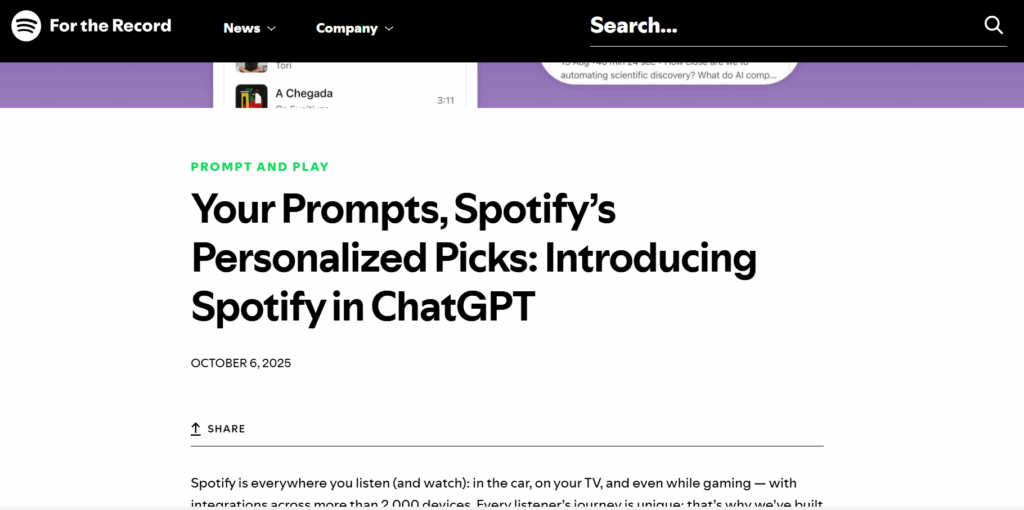
To connect Spotify with ChatGPT, open a ChatGPT conversation and simply mention Spotify in your prompt—for example, “Use Spotify to make me a rainy-day playlist.” On first use you’ll see a prompt to connect; click the button (you may see “Use Spotify for this answer”), sign in to Spotify, and authorize the link. From then on, ask for songs, albums, playlists, or podcasts, and tap any result to open it in the Spotify app. You can disconnect anytime in settings.
About The Author

Joeran Beel
I am the founder of Recommender-Systems.com and head of the Intelligent Systems Group (ISG) at the University of Siegen, Germany https://isg.beel.org. We conduct research in recommender-systems (RecSys), personalization and information retrieval (IR) as well as on automated machine learning (AutoML), meta-learning and algorithm selection. Domains we are particularly interested in include smart places, eHealth, manufacturing (industry 4.0), mobility, visual computing, and digital libraries. We founded or maintain, among others, LensKit-Auto, Darwin & Goliath, Mr. DLib, and Docear, each with thousand of users; we contributed to TensorFlow, JabRef and others; and we developed the first prototypes of automated recommender systems (AutoSurprise and Auto-CaseRec) and Federated Meta Learning (FMLearn Server and Client).